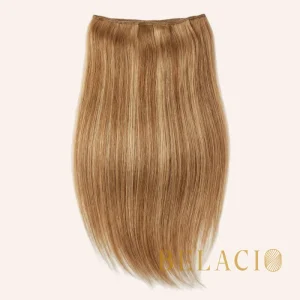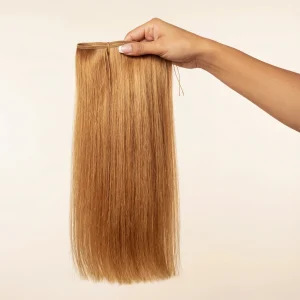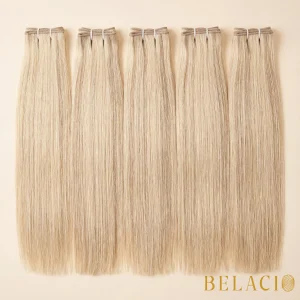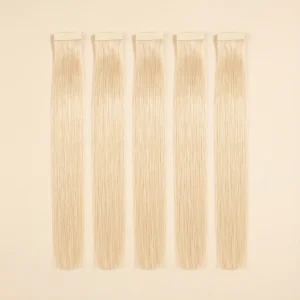

Blonde clip-in hair extensions fade faster than any other extension color because the bleaching process that creates the blonde shade removes the hair’s natural melanin protection, leaving it 2–3 times more vulnerable to UV damage, chlorine discoloration, and heat-induced brassiness. The five most common mistakes — skipping UV protection, using the wrong shampoo, overheating, choosing the wrong blonde shade for your skin tone, and buying poorly processed hair — can turn a $200 blonde set brassy orange within weeks. Every one of these is fixable.
Key Takeaways
- Blonde extensions fade 2–3 times faster than natural-colored extensions because the bleaching process removes melanin, the hair’s built-in UV and environmental shield.
- Purple shampoo every 2–3 washes is the single most effective anti-brassiness tool — it deposits cool violet pigments that neutralize the yellow-orange tones that develop from oxidation and sun exposure.
- Blonde human hair clip-ins have a reduced heat tolerance of 356°F (180°C) compared to 410°F for natural-colored hair — exceeding this threshold accelerates protein damage and yellowing.
- The #613 platinum blonde shade works best with warm olive and medium-warm Caribbean skin tones when it has a soft buttery-cream undertone, not an icy-stark platinum.
- Chlorine turns blonde extensions green, not brassy — the fix is a pre-swim soak in fresh water and a chlorine-removal shampoo after every pool session.
- Quality blonde processing takes 15–20 days of gradual lightening to preserve cuticle integrity, while cheap alternatives rush the process in hours, producing hair that degrades within the first month.
Mistake 1: Skipping UV Protection on Blonde Extensions
UV radiation fades blonde clip-in hair extensions 2–3 times faster than dark extensions because blonde hair lacks melanin, the natural pigment that absorbs and deflects ultraviolet light. Without melanin, UV rays penetrate directly into the hair’s keratin structure, breaking down the artificial color molecules that create the blonde shade. In Caribbean sunlight, this process can shift your platinum blonde toward a brassy warm tone in as little as 2–3 weeks of regular outdoor exposure.
I learned this during my first summer testing blonde extensions in Puerto Rico. A set of #613 blonde clip-ins that looked perfect in January started showing warm golden patches by March — and I’m talking about hair that I only wore 3–4 times per week. The UV exposure in our latitude is no joke.
The fix is straightforward: apply a UV-protective leave-in conditioner (look for SPF 15 or higher specifically formulated for hair) every time you clip in your blonde extensions. This creates a barrier between the UV rays and the exposed keratin. For days at the beach or extended outdoor events, layer a UV spray on top of the leave-in. And here’s a trick most brands won’t tell you — a wide-brimmed hat does more for your blonde extensions than any product. Ten minutes of direct Caribbean sun at midday delivers more UV damage than an hour of early morning exposure.
Mistake 2: Using Regular Shampoo Instead of Purple Shampoo
Regular shampoo cleans blonde extensions but does nothing to counteract the natural oxidation process that turns blonde hair brassy, while purple shampoo deposits cool violet pigments that neutralize yellow-orange tones every time you wash. Skipping purple shampoo is the number one reason blonde clip-ins lose their cool, clean tone within the first month.
Here’s the hair science in plain language. Blonde extensions are created by lifting (bleaching) the natural dark pigment out of the hair shaft. What’s left behind are warm undertones — yellow, orange, gold — that the toning process suppresses. Over time, oxidation from air, water, and environmental exposure brings those warm undertones back to the surface. That’s brassiness.
Purple shampoo works because purple sits opposite yellow on the color wheel. When you wash with it, the violet pigments neutralize the yellow tones, pushing the blonde back toward a cool, clean shade. The key is consistency: use purple shampoo every 2–3 washes (not every wash — too frequent use can over-tone and leave a grayish cast).
For Caribbean climates specifically, I recommend alternating between purple shampoo and a sulfate-free moisturizing shampoo. The humidity here already stresses blonde extensions. Stripping moisture with every wash accelerates the dryness and porosity cycle that makes brassiness worse. Your rotation should look like this: sulfate-free wash, sulfate-free wash, purple shampoo wash. Repeat.
Mistake 3: Overheating Blonde Extensions
Blonde clip-in extensions have a reduced heat tolerance of 356°F (180°C) compared to 410°F (210°C) for natural-colored human hair extensions because the bleaching process weakens the protein cross-links in the hair shaft, making blonde hair more susceptible to heat-induced damage and yellowing. Using a flat iron or curling wand at the same temperature you’d use on your natural hair or dark extensions can permanently yellow blonde clip-ins.
This is one of the most expensive mistakes I’ve seen. A client brought in a 6-week-old set of blonde extensions that had yellowed at the ends — exactly where she’d been clamping her flat iron. The heat hadn’t just damaged the color. It had denatured the keratin proteins, creating a texture change that no amount of toning could reverse.
The fix involves two adjustments. First, always use a heat protectant spray before any thermal styling on blonde extensions. This is non-negotiable. Second, keep your tools at or below 350°F for blonde hair. Most professional flat irons and curling wands have adjustable temperature settings — drop them 50–60 degrees from whatever you use on natural dark hair. The styling result is the same. The damage isn’t.
And if you’re in a rush and tempted to crank the heat? Don’t. One pass at 400°F does more permanent damage to blonde extensions than three passes at 320°F. Lower temperature, more passes. That’s the rule.
Mistake 4: Choosing the Wrong Blonde Shade for Your Skin Tone

The biggest visual mistake with blonde clip-in extensions is choosing a shade based on what looks good on the model in the product photo rather than matching the blonde’s undertone to your own skin’s undertone — warm skin with cool platinum blonde creates a jarring contrast that makes the extensions look obviously fake. For Caribbean women with warm olive or medium-warm skin tones, a buttery-cream blonde (#613 with neutral-warm undertones) blends far more naturally than an icy platinum.
Let me break down the undertone matching that actually works:
| Your Skin Undertone | Best Blonde Shade | Avoid |
|---|---|---|
| Warm olive (most Caribbean Latinas) | #613 buttery-cream, caramel blonde, golden blonde | Icy platinum, ash blonde, silver-toned blondes |
| Neutral (mix of warm and cool) | #613 neutral, dirty blonde, light ash blonde | Pure golden or pure platinum |
| Cool (pink/red undertones) | Ash blonde, platinum, light blonde | Honey blonde, golden blonde, warm caramel |
The shade that works for most Caribbean women? A Level 9 pale creamy champagne blonde — warm enough to complement olive skin but light enough to read as “blonde” rather than “light brown.” That’s the #613 specification, and the undertone matters more than the lightness level.
If you’re not sure about your undertone, try this test: look at the veins on the inside of your wrist in natural daylight. Green veins indicate warm undertones. Blue or purple veins indicate cool. A mix of both means neutral. Match your blonde shade accordingly and you’ll save yourself the frustration of a clip-in set that looks beautiful in the box but wrong on your head.
Mistake 5: Buying Poorly Processed Blonde Hair
The difference between blonde clip-in extensions that last 12 months and ones that degrade in 4 weeks comes down to processing speed — quality blonde hair is lightened gradually over 15–20 days to preserve cuticle integrity, while cheap alternatives use aggressive bleaching in hours that strips the hair’s protective structure permanently. This is the mistake that costs the most money per wear because you end up replacing the extensions 3–4 times per year instead of once.
When Vietnamese hair is lightened from its natural Level 1–2 (black) to Level 9–10 (blonde), the bleaching agent breaks down melanin pigments in the cortex. Done slowly and carefully, the cuticle layer — those overlapping scales that protect the hair shaft — remains largely intact. Done quickly with high-volume peroxide, the cuticle is blown open and can’t fully close again. That’s why cheap blonde extensions feel silky for a week (the silicone coating is still in place) and then turn dry, tangled, and strawlike once the coating washes away.
Here’s what to ask any blonde extension supplier:
- What is the lightening timeline? If they can’t tell you or it’s less than a week, the processing is too aggressive.
- Is the hair coated with silicone? Quality blonde extensions don’t need it. Silicone masks damage temporarily.
- What is the heat tolerance? Properly processed blonde human hair tolerates 350–360°F. If they claim 400°F+ for blonde, the specs are unrealistic.
- Where does the hair originate? Vietnamese hair’s thick strand diameter (70–100 microns) holds blonde processing better than finer Indian or European-origin hair, producing less breakage and more consistent color.
The cost difference between well-processed and poorly processed blonde extensions is typically 25–35% at the wholesale level. On a $150 set, that’s $37–$52 more upfront. But when the cheap set needs replacing in 6 weeks and the quality set lasts 12 months, the cost-per-wear calculation isn’t even close.
How to Keep Your Blonde Clip-Ins Looking Fresh Long-Term

A consistent 3-step maintenance routine — UV protection before every wear, purple shampoo every third wash, and heat tools capped at 350°F — extends the color vibrancy of blonde clip-in extensions from the typical 4–6 months to 10–12 months on quality human hair. That’s the difference between replacing your set once a year versus three times.
Here’s the complete blonde clip-in care protocol for tropical climates:
- Before clipping in: Apply UV-protective leave-in conditioner from mid-shaft to ends. Let it dry 2 minutes before installing.
- After removing: Air out for 30 minutes before storing. Never store blonde extensions while damp — moisture in a closed bag accelerates brassiness.
- Wash day (every 15–20 wears): Alternate between sulfate-free shampoo and purple shampoo on a 2:1 ratio. Deep condition with a protein-based mask after every purple shampoo wash.
- Weekly: Apply a lightweight hair oil (argan or jojoba) to the ends only — blonde ends are the most porous section and need consistent moisture.
- Monthly: If brassiness is creeping in despite purple shampoo, a professional toner refresh ($25–$40 at most salons) resets the blonde tone completely.
- Storage: Lay flat in a silk or satin bag away from direct light. UV exposure even during storage can shift blonde tones over time.
What Blonde Shade Works Best for Caribbean Skin Tones?
The #613 Level 9 pale creamy champagne blonde with neutral-warm undertones is the most universally flattering blonde shade for Caribbean women because it complements the warm olive and golden-undertone skin tones that dominate Puerto Rican, Dominican, and Colombian complexions. Icy platinum reads as costume-like on warm skin, while dirty blonde can look muddy rather than dimensional.
If you’re not ready to commit to a full blonde set, consider starting with a few blonde clip-in wefts mixed into your natural dark hair for a balayage effect. Two blonde wefts clipped into the mid-lengths and one at the face frame create dimensional highlights without the maintenance commitment of a full blonde head. This is also the safest way to test whether blonde suits your skin tone before investing in a complete set.
For women who want the full blonde experience without permanent commitment, Belacio’s #613 Blonde Tape-In Extensions offer a semi-permanent option with the same Vietnamese hair quality and 15–20 day gentle lightening process. The tape-in format means a stylist installs them in 30–60 minutes, they last 6–8 weeks per cycle, and the color stays true because the hair was processed to last — not to sell cheaply.
Preguntas Frecuentes
Why do blonde clip-in extensions fade faster than dark extensions?
Blonde extensions fade faster because the bleaching process removes melanin, the natural pigment that protects hair from UV, oxidation, and environmental damage. Without melanin, blonde hair is 2–3 times more vulnerable to color shift from sun exposure, heat, and water chemistry.
How often should I use purple shampoo on blonde clip-ins?
Use purple shampoo every 2–3 washes, alternating with a sulfate-free moisturizing shampoo. Using purple shampoo at every wash can over-deposit violet pigments, leaving a grayish or dull cast. The 2:1 rotation (two regular washes, one purple) maintains tone without over-correction.
What temperature should I use when styling blonde clip-in extensions?
Keep heat tools at or below 356°F (180°C) for blonde human hair extensions. The bleaching process reduces heat tolerance by 25–50°F compared to unprocessed hair. Always apply heat protectant before thermal styling.
How do I choose the right blonde shade for my skin tone?
Match the blonde’s undertone to your skin’s undertone. Warm olive skin (most Caribbean women) pairs best with buttery-cream or neutral blondes like #613. Cool-toned skin works with ash or platinum blondes. Check your wrist veins in natural light: green indicates warm, blue indicates cool, both means neutral.
Will chlorine turn my blonde extensions green?
Yes. Chlorine deposits copper compounds on blonde hair that create a green tint. Prevent this by soaking your extensions in fresh water before swimming (saturated hair absorbs less chlorine) and washing with a chelating or chlorine-removal shampoo after every pool session.
How long do blonde clip-in extensions last with proper care?
Quality blonde human hair clip-in extensions last 10–12 months of color vibrancy with consistent care (UV protection, purple shampoo rotation, heat cap at 356°F). The hair itself remains usable for 12–36 months. Poorly processed blonde may lose vibrancy in 4–6 weeks.
What is the difference between #613 blonde and dirty blonde extensions?
Level 9 #613 is a pale creamy champagne blonde — light, bright, and head-turning. Dirty blonde sits at Level 7–8, a darker, more muted blonde that blends naturally with brown hair. #613 requires more maintenance (purple shampoo, UV protection) while dirty blonde is more forgiving.
Tu Próximo Paso
Now you know the five mistakes that kill blonde clip-ins fast — and the fixes that keep them looking salon-fresh for months. The real secret isn’t just maintenance. It’s starting with hair that was processed correctly in the first place. Fifteen-to-twenty-day gradual lightening on thick Vietnamese strands produces a blonde that actually lasts, not a blonde that photographs well for one week.
If you’re exploring blonde for the first time, check out Belacio’s #613 Blonde Tape-In Extensions or the Light Blonde Straight Weft Extension for a longer-term blonde experience with the same fade-resistant quality. Not sure which blonde works with your skin tone? Send me a selfie on WhatsApp at 787-671-7122 and I’ll match you to the right shade before you spend a cent.