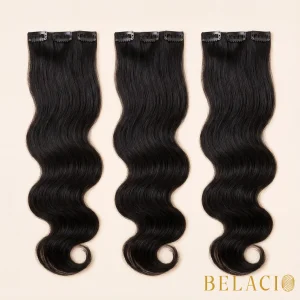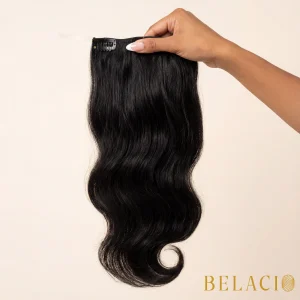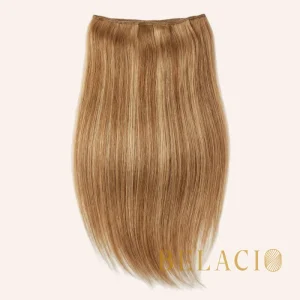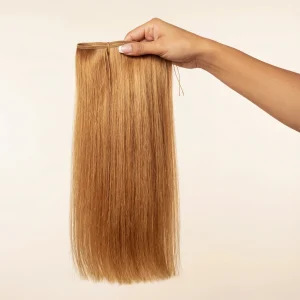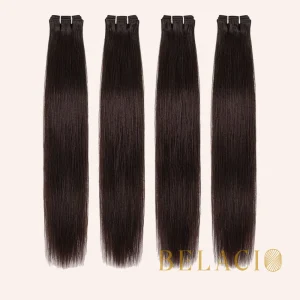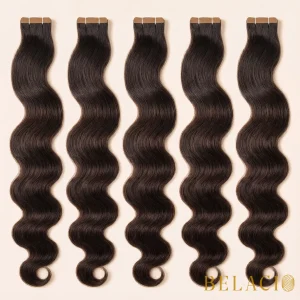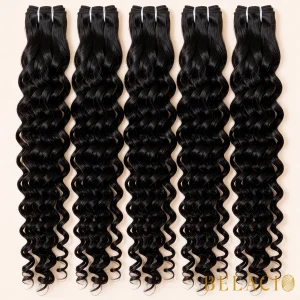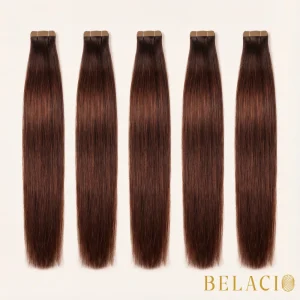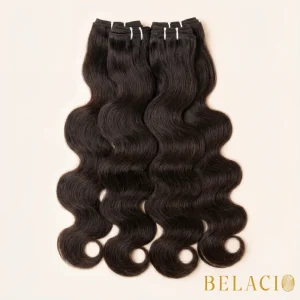
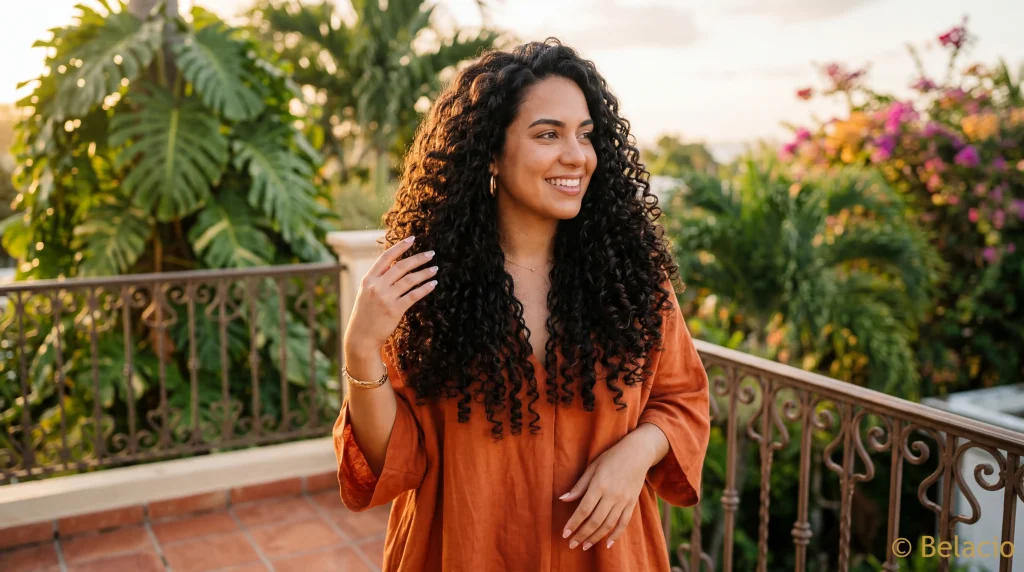
Curly clip in hair extensions blend seamlessly when the curl pattern matches your natural texture within one curl type on the Andre Walker Hair Typing System. Type 3A through 3B curly clip-ins made from 100% human hair hold their spiral pattern for 12 to 36 months in tropical humidity, while synthetic curly clip-ins lose definition within 2 to 4 weeks.
Key Takeaways
- Curl Pattern Matching Is Everything: The single biggest reason curly clip-ins look fake is a mismatch between the extension curl and your natural curl. Matching within one curl sub-type (3A to 3B, for example) creates invisible transitions.
- Human Hair Holds Curl Longer: Real human hair curly clip-ins maintain their spiral pattern through washing, humidity, and styling for 12 to 36 months. Synthetic fibers lose curl definition permanently after heat or moisture exposure.
- Tropical Humidity Advantage: Curly textures actually perform better than straight extensions in Caribbean humidity (75 to 85%) because natural curls absorb and release moisture without frizzing the way misaligned straight fibers do.
- Weight Matters More for Curls: Curly clip-ins appear 30 to 40% shorter than their measured length because curls spring upward. A 22-inch curly set hangs to approximately 16 inches, so order 4 to 6 inches longer than your desired length.
- Double-Drawn Density: Double-drawn curly extensions maintain consistent curl volume from root to tip. Single-drawn sets develop thin, stringy ends within months as shorter strands shed first.
- Price Range Clarity: Quality human hair curly clip-ins range from $120 to $300 per set depending on curl tightness, length, and processing level. Tighter curls (3C to 4A) cost more because the curling process requires more raw hair per finished inch.
Why Curly Clip In Hair Extensions Are the Hardest to Get Right
Curly clip in hair extensions have the highest return rate in the extension industry because curl pattern blending requires more precision than straight or wavy textures. A straight extension that is slightly off-color still looks passable. A curly extension with the wrong spiral diameter looks immediately fake, creating a visible boundary between your natural curls and the added pieces.
The challenge comes down to three variables: curl diameter, curl direction, and strand behavior in humidity. Your natural Type 3B curls might spiral clockwise with a pencil-width diameter. If the extensions spiral counterclockwise with a marker-width diameter, no styling will make them blend.
Te confieso algo: yo también pasé por eso. I spent over $400 on curly clip-ins that looked gorgeous in the package and ridiculous on my head. The curl pattern was close but not close enough, and in Fajardo’s humidity, the difference became obvious within hours.
How to Match Curly Clip In Extensions to Your Natural Curl Pattern
Selecting curly clip in hair extensions that blend requires understanding the Andre Walker Hair Typing System, which classifies curls from Type 2 (wavy) through Type 4 (coily). Your best match falls within one sub-type of your natural pattern, not an exact duplicate.
| Your Natural Curl | Best Extension Match | Curl Description | Why It Works |
|---|---|---|---|
| Type 2C (Deep Wave) | Soft Wavy to 3A | Loose S-curves, wine-cork diameter | Bridges the wave-to-curl transition naturally |
| Type 3A (Loose Curl) | 3A to 3B | Sidewalk-chalk diameter spirals | Closest universal blend for Caribbean textures |
| Type 3B (Medium Curl) | 3A to 3B | Marker-width, defined bouncy curls | The most common Caribbean curl type |
| Type 3C (Tight Curl) | 3B to 3C | Pencil-width, densely packed spirals | Requires human hair for humidity stability |
| Type 4A (Coily) | 3C to 4A | Crochet-needle-width, springy coils | Highest shrinkage factor, order 6+ inches longer |
The hair cuticle structure determines how curls behave in humidity. Human hair cuticles respond to moisture by swelling slightly, which actually tightens curls. This means human hair curly clip-ins blend better in tropical environments over time, while synthetic fibers either go limp or frizz uncontrollably.

5 Approaches to Finding Curly Clip Ins That Actually Blend
Curly clip in hair extensions that truly blend share five non-negotiable qualities. Each approach below addresses a specific blending challenge that causes most curly clip-in purchases to fail.
1. Prioritize Curl Type Over Brand Name
The most expensive curly clip-ins on the market will look terrible if the curl pattern does not match yours. Before comparing brands, identify your exact curl sub-type using the Andre Walker system. Take a photo of your freshly washed, air-dried curls and compare the spiral diameter to the product photos.
Look for brands that label by curl type (3A, 3B, 3C) rather than vague descriptions like “curly” or “spiral.” Vague labeling signals that the manufacturer does not control the curl consistency across batches. Específicamente en el Caribe, where humidity amplifies every curl mismatch, this precision matters more than anywhere else.
2. Choose Human Hair Over Synthetic for Tropical Climates
Synthetic curly clip-ins cost 50 to 70% less than human hair options, but they cannot survive Caribbean humidity. Synthetic fibers hold a fixed curl pattern from heat molding. When tropical moisture enters the fiber, the curl relaxes permanently. One humid day outdoors can destroy a $60 synthetic set.
Human hair curly clip-ins adapt to humidity the way your natural hair does. The cuticle absorbs moisture, the curl tightens slightly, and the pattern remains intact. After washing, the original curl springs back. This resilience makes human hair the only viable option for women in Puerto Rico, the Dominican Republic, or anywhere with 70%+ humidity.
3. Demand Double-Drawn Construction
Double-drawn curly extensions contain 90%+ strands of uniform length, creating consistent curl volume from the weft to the tips. Single-drawn sets mix long and short strands. The short strands curl tighter and shed first, leaving the extensions progressively thinner and stringier over time.
Cuando viajé a Vietnam y visité más de 25 fábricas, the difference between single-drawn and double-drawn curly bundles was striking. Single-drawn looked full in the factory but deflated after one wash. Double-drawn maintained that bouncy, defined-curl density that makes clip-ins look like your own hair.
4. Test the Blend Before Full Installation
Before committing to a full set, install just one weft panel at the crown and test the blend in three conditions: indoor air conditioning, outdoor humidity, and after light physical activity.
If the test panel blends indoors but separates outdoors, the extension curl is likely synthetic or poorly processed human hair reacting differently to moisture than your natural curls. Truly compatible curly clip-ins behave identically to your own hair across all conditions.
5. Invest in Professional Color Matching for Curly Textures
Curly hair refracts light differently than straight hair, creating the illusion of lighter tones at the curl peaks and darker tones in the valleys. A color that matches your straight hair may appear one to two shades off when curled.
Mija, this one saved me hundreds in returns. My natural 1B looks almost like a #2 dark brown when my curls are fully defined because light catches the raised spiral. Getting extensions in true 1B instead of the lighter shade I thought I needed made the blend disappear.

How to Install Curly Clip In Hair Extensions Without Visible Tracks
Installing curly clip-ins differs from straight extension installation because curly hair’s natural volume creates both challenges and advantages. The volume hides tracks more easily, but improper placement creates lumps and irregular curl direction.
Section your hair using a rat-tail comb in curved horizontal parts rather than straight lines. Straight parts create a visible linear gap in curly hair where the curl pattern breaks. Curved parts follow the natural fall of spirals, making the section line invisible.
Apply each weft panel with clips positioned half an inch below the part line. This offset allows your natural curls to cascade over the weft, hiding the attachment completely. Tease the roots lightly at each attachment point, but less aggressively than for straight clip-ins because curly textures grip clips naturally.
After all panels are installed, use a wide-tooth pick to gently lift and merge your natural curls with the extension curls at each transition point. Do not brush. The American Academy of Dermatology recommends detangling curly hair only when wet and conditioned, and this applies equally to extensions. Dry brushing separates and destroys curl definition in both natural and extension hair.
How to Care for Curly Clip In Hair Extensions
Curly clip in hair extensions require a different care routine than straight sets because the curl pattern traps more moisture, product, and debris between spirals. Proper care preserves curl definition and the cuticle health that makes human hair last years.
Las cositas clave del mantenimiento:
- Co-wash instead of shampooing. Use a silicone-free conditioner to gently cleanse the curls every 10 to 15 wears. Full shampoo strips the moisture that keeps curls defined and bouncy.
- Detangle only when wet and conditioned. Apply a generous amount of conditioner, then use a wide-tooth comb from tips to roots. Never dry-detangle curly extensions because dry friction causes permanent frizz.
- Air-dry on a microfiber towel. Regular towels create friction that disrupts curl formation. Lay the extensions flat on microfiber, scrunch gently, and allow 6 to 8 hours for complete drying.
- Refresh curls with a water-and-conditioner spray. Between washes, mist the curls with a 3:1 water-to-conditioner mix and scrunch to reactivate the pattern without a full wash.
- Store on a satin-covered extension hanger. Unlike straight clip-ins that store flat, curly clip-ins maintain better curl pattern when hung vertically. Gravity keeps the spirals elongated and tangle-free.
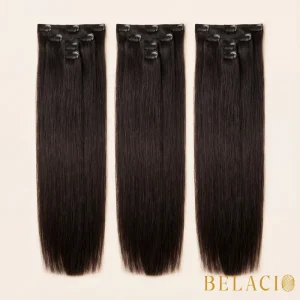
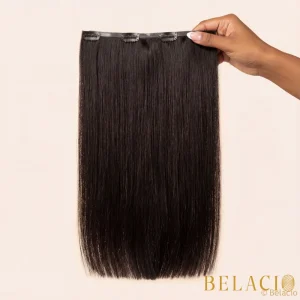
Avoid heat styling curly clip-ins unless necessary. While human hair tolerates up to 410°F, repeated heat straightening and re-curling weakens the engineered curl pattern over time. If you want a straight look occasionally, Belacio’s straight clip-in extensions give you that versatility without compromising your curly set.
How Much Do Curly Clip-in Extensions Cost?
Quality curly clip in hair extensions range from $120 to $500 per set depending on curl type, hair origin, and gram weight. Tighter curl patterns (3C to 4A) cost 15 to 25% more than looser curls (3A to 3B) because the curling process requires more raw straight hair to produce each finished inch of curled extension.
| Curl Type | Typical Price Range | Why the Price Varies |
|---|---|---|
| 3A Loose Curl | $120 to $250 | Less raw hair per finished inch, simpler curl processing |
| 3B Medium Curl | $150 to $300 | Moderate shrinkage factor, balanced hair-to-curl ratio |
| 3C Tight Curl | $180 to $400 | High shrinkage (40 to 50%), requires significantly more raw hair |
| 4A Coily | $200 to $500 | Highest shrinkage (50 to 75%), most raw material per finished set |
For Caribbean women, the investment in human hair curly clip-ins pays off within 3 to 4 months. A $180 human hair set worn twice weekly for 12 months costs approximately $1.73 per use. A $60 synthetic set that loses curl after 3 weeks of tropical exposure effectively costs $60 per use, making it 35 times more expensive per wear.
Belacio Hair sources curly extensions from Vietnamese factories where the naturally thick strand diameter holds curl formation longer than thinner Indian or Brazilian sources. Factory-direct pricing eliminates the middleman markup that pushes many curly clip-in brands above $300.
What Makes Vietnamese Human Hair Ideal for Curly Extensions?
Vietnamese human hair produces superior curly extensions because of three structural characteristics: naturally thick strand diameter (70 to 100 micrometers), low porosity cuticle layer, and high keratin density. These combine to hold engineered curl patterns longer than any other hair origin in tropical climates.
Thick strands have more structural memory. When Vietnamese hair is curled using steam processing (no chemicals), the keratin bonds reform at the new curl angle and resist reverting even under extreme humidity. Thinner hair origins lose their engineered curl faster because the strand lacks internal mass to maintain shape.
Low porosity prevents excess moisture absorption. In Caribbean humidity, high-porosity hair absorbs atmospheric moisture until the curl pattern swells, frizzes, and straightens. Vietnamese hair’s low porosity creates a natural humidity shield that keeps curls defined from morning to night.
Frequently Asked Questions
Do curly clip in hair extensions damage natural curly hair?
Curly clip-ins cause minimal damage when removed nightly and repositioned slightly each day. The silicone-backed clips grip without pulling, and the weight distribution across multiple attachment points prevents the traction stress that causes breakage in permanent methods.
How do you sleep with curly clip in hair extensions?
Remove curly clip-ins before sleeping. Store them on a satin-covered hanger to maintain curl pattern overnight. Sleeping in clip-ins creates friction that tangles both the extensions and your natural curls, leading to matting and breakage.
Can you straighten curly clip in hair extensions?
Human hair curly clip-ins can be straightened with a flat iron up to 410°F. The original curl pattern returns after the next wash. Synthetic curly extensions cannot be straightened without permanently destroying the curl pattern.
How often should you wash curly clip in hair extensions?
Wash curly clip-ins every 10 to 15 wears using the co-wash method (conditioner only, no shampoo). Overwashing strips the natural moisture that keeps curls bouncy and defined. Refresh between washes with a water-and-conditioner spray.
What is the best length for curly clip in hair extensions?
Order curly clip-ins 4 to 6 inches longer than your desired final length to account for curl shrinkage. A 22-inch curly set typically hangs to approximately 16 inches when fully curled, depending on the tightness of the pattern.
Do curly clip in hair extensions tangle easily?
Human hair curly clip-ins with intact cuticle alignment (Remy quality) resist tangling because the cuticle scales all face the same direction. Non-Remy curly extensions tangle aggressively because opposing cuticle scales lock together like Velcro during wear.
How many curly clip in hair extension pieces make a full head?
A full head of curly clip-ins requires 6 to 10 weft pieces totaling 120 to 220 grams. Curly textures need more gram weight than straight extensions to achieve equivalent visual volume because the curl pattern compresses the apparent fullness.
Your Next Step Towards Curls That Shine
Finding curly clip in hair extensions that actually blend comes down to precision, not price. Match the curl type within one sub-category of your natural pattern, choose human hair over synthetic for tropical climates, and demand double-drawn construction for long-term density.
Ahora que sabes exactamente qué buscar, the next step is putting that knowledge to work. If you are new to clip-in extensions, start with a single test panel in your curl type before committing to a full set. This $30 to $50 experiment saves hundreds in returns.
For women across Puerto Rico and the Caribbean, Belacio Hair offers Vietnamese human hair extensions starting at $120, sourced from factories that Natalia Blanco Torres personally evaluated across 25+ locations in Vietnam. Call (787) 671-7122 for personalized curl-matching guidance, or visit the clip-in collection to browse available textures.
The right curly clip-ins do not just add length. They complete the curl pattern you were already building.