
You’ve heard suppliers throw around “virgin” and “Remy” like interchangeable badges of quality—but one order arrives silky and manageable while the next tangles into a matted mess within weeks. Sound familiar?
If you’re building extension services at your salon, understanding the real difference between virgin hair and Remy hair isn’t just industry trivia. It’s the knowledge that separates stylists who confidently guarantee their work from those constantly apologizing to clients and eating replacement costs.
The main difference between virgin hair and Remy hair comes down to processing history versus cuticle alignment. Virgin hair has never been chemically treated—no coloring, perming, or bleaching—and typically comes from a single donor with complete cuticle integrity intact. Remy hair describes cuticle direction alignment, where all strands flow in the same root-to-tip direction to prevent tangling. These terms describe different quality characteristics, not interchangeable grades—and hair can be both, only one, or neither.
What Is the Difference Between Virgin Hair and Remy Hair?
Virgin hair is defined as hair that has never undergone chemical processing of any kind. It comes from a single donor, preserving the natural color, texture, and complete cuticle structure exactly as it grew. Remy hair refers to cuticle alignment—all strands oriented in the same root-to-tip direction—regardless of whether the hair has been processed or colored.
Here’s where it gets interesting: premium hair extensions are typically both virgin AND Remy. The virgin designation tells you about chemical processing history—none has occurred. The Remy designation tells you about how the hair cuticle’s protective structure affects extension performance and whether the scales remain aligned to prevent friction between strands.
The confusion happens because many suppliers use “Remy” as shorthand for “high quality.” But Remy only describes alignment—it says nothing about whether hair has been bleached, dyed, or chemically relaxed. You can have Remy hair that’s been heavily processed, and you can have virgin hair that wasn’t properly aligned during collection.
For salon professionals, this distinction matters enormously. Virgin Remy hair—unprocessed AND properly aligned—delivers the longest lifespan and most natural movement. Hair that’s only Remy (aligned but processed) may perform well initially but shows faster deterioration. Hair that’s neither virgin nor Remy? That’s where client complaints and reputation damage live.
When evaluating suppliers, ask specifically: Is this hair virgin? Is it Remy? Understanding how double-drawn and single-drawn construction affects hair density and quality adds another quality dimension, but virgin and Remy status remain your baseline quality indicators.
Why Cuticle Alignment Determines Extension Performance
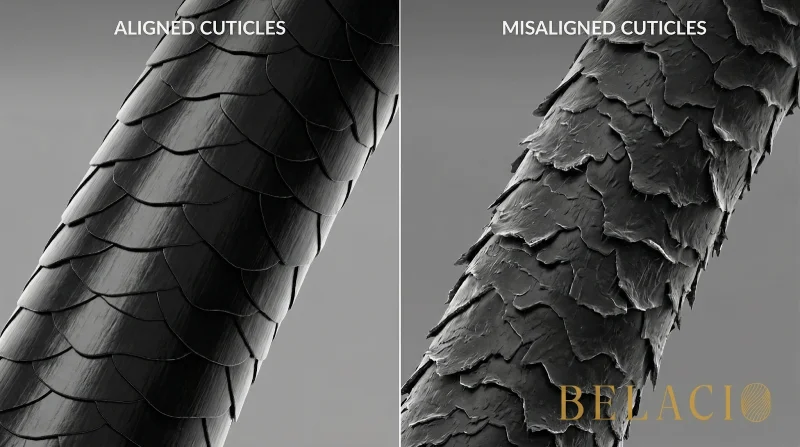
Cuticle alignment directly impacts tangling resistance, styling longevity, and extension lifespan. When cuticle scales face the same direction—root to tip—hair fibers glide smoothly against each other. Misaligned cuticles create friction that causes matting within weeks, especially in high-humidity environments like Puerto Rico’s 75-85% average humidity.
Think of cuticle scales like overlapping shingles on a roof. When they all point the same direction, water and products flow smoothly down the strand. When scales point opposite directions, they catch against each other with every movement—every brush stroke, every head turn, every humid afternoon.
Research on hair structure shows that each strand contains keratin proteins held together by disulfide bonds. Chemical processing breaks these bonds, weakening the hair’s structural integrity. But even without chemical damage, misaligned cuticles create mechanical stress that accelerates deterioration.
Here’s what happens with non-Remy hair: manufacturers strip the cuticle layer entirely using acid baths, then coat the damaged strands with silicone to create temporary smoothness. The hair feels great initially. But as that silicone coating washes away over 4-8 weeks, you’re left with structurally compromised hair that tangles, mattes, and looks increasingly artificial.
The lifespan comparison is stark. Non-Remy silicone-coated hair typically shows visible deterioration within 4-8 weeks. Properly aligned virgin Remy hair, with appropriate care, lasts 12-18 months for many clients. In tropical humidity, this difference becomes even more pronounced—the moisture opens cuticle scales wider, amplifying any alignment problems exponentially.
How to Identify True Virgin and Remy Hair Before Purchasing
To identify quality hair, look for these four verification methods: the touch test (natural texture variation rather than uniformly silky feel), the burn test (clean ash smell versus plastic odor), the tangle test (wet hair should detangle easily), and documentation review (origin certificates and facility certifications like SA 8000 social accountability standards for ethical manufacturing verification).
The touch test reveals processing history your eyes might miss. Run your fingers along several strands. Virgin hair has natural texture variation—slight differences in thickness, subtle waviness even in “straight” hair. Over-processed hair feels artificially uniform, almost too silky and consistent.
Visual inspection adds another layer. Look for subtle color variation along individual strands, which indicates natural hair. Flat, single-tone color from root to tip often signals processing, even if the supplier claims virgin status.
The wet behavior test is particularly revealing. Submerge a sample in water and run your fingers through it. Quality cuticle-aligned hair maintains manageability when wet, detangling with reasonable effort. Poor quality hair immediately begins matting, requiring excessive force that would damage natural hair.
According to certification standards, SA 8000:2014 certification verifies ethical labor practices and supply chain transparency—but it also signals operational legitimacy. Suppliers with facility certifications have submitted to third-party audits. They’re accountable in ways that fly-by-night operations aren’t.
Request documentation before committing to any wholesale relationship. Origin certificates, processing disclosure, and willingness to provide samples before large orders indicate suppliers confident in their product quality. When you’re ready to explore wholesale hair extension options designed specifically for salon professionals, prioritize partners who welcome scrutiny.
Red Flags That Signal Mislabeled or Low-Quality Hair
Watch for these warning signs when evaluating suppliers: unusually low pricing without explanation, reluctance to provide origin documentation, inconsistent texture between samples and bulk orders, excessive shine indicating silicone coating, and vague terminology like “human hair blend” without specifics. Legitimate suppliers welcome quality questions.
The price signal is straightforward. If pricing seems too good for the claimed quality grade, the claims are probably false. Virgin hair from Vietnamese highland donors involves real costs—ethical collection, careful processing, quality control. Dramatically lower prices mean corners are being cut somewhere.
Documentation avoidance is your biggest red flag. Quality suppliers proactively share certifications and origin information. They’re proud of their supply chain. Evasiveness—vague answers, deflection, “proprietary” claims about basic sourcing questions—indicates problems they don’t want you discovering.
Batch inconsistency destroys client relationships. If your first order arrives beautifully and your third order tangles immediately, you’re dealing with a supplier who mixes sources or can’t maintain quality control. Consistent quality requires consistent sourcing, and that requires operational discipline many suppliers lack.
Watch for coating signs: hair that’s overly shiny and slippery often indicates silicone masking damaged cuticles. Acid-treated non-Remy hair gets coated to simulate the smoothness of properly aligned cuticles. It works temporarily. Then it doesn’t.
Questions legitimate suppliers answer readily: Where specifically is this hair sourced? What processing has it undergone? Can you provide facility certification documentation? Can I order samples before committing? Any hesitation on these basics should send you elsewhere.
For comprehensive verification protocols, the complete professional guide to verifying hair extension quality before purchasing walks through additional testing methods.
Key Takeaways
In summary, here are the essential points for evaluating virgin and Remy hair:
- Virgin describes processing history (none), while Remy describes cuticle alignment (all strands root-to-tip)—they measure different quality characteristics and premium hair should be both.
- Cuticle alignment determines tangling resistance and becomes critical in high-humidity environments where moisture opens scales and amplifies friction between misaligned strands.
- Silicone-coated non-Remy hair deteriorates within 4-8 weeks as the coating washes away, while properly aligned virgin Remy hair can last 12-18 months with appropriate care.
- Four verification tests—touch, burn, tangle, and documentation—help identify true quality before committing to wholesale purchases.
- Supplier transparency signals product quality—willingness to provide certifications, samples, and sourcing details indicates confidence in their supply chain.
Frequently Asked Questions
Can hair be Remy but not virgin?
Yes—Remy only describes cuticle alignment, not processing history. Hair can be colored, bleached, or chemically treated and still qualify as Remy if the cuticle scales remain aligned in the same direction. This hair may perform well initially but typically shows faster deterioration than virgin Remy alternatives.
Why does humidity affect hair extension performance?
Humidity causes cuticle scales to swell and lift slightly. In properly aligned Remy hair, this creates minimal friction. In misaligned or non-Remy hair, the lifted scales catch against each other, accelerating tangling and matting. Puerto Rico’s 75-85% year-round humidity makes cuticle alignment especially critical for client satisfaction.
How can I tell if hair has silicone coating?
Silicone-coated hair feels unusually slippery and has an artificial shine that natural hair lacks. The coating often creates a “squeaky” feeling when rubbed between fingers. Most tellingly, the hair may feel dramatically different after several washes as the coating begins washing away.
What does SA 8000 certification indicate about hair suppliers?
SA 8000:2014 certification verifies that a facility meets international standards for ethical labor practices, including fair wages, safe working conditions, and supply chain transparency. While not a direct measure of hair quality, it indicates operational legitimacy and accountability that correlate with consistent product standards.
Should I always request samples before wholesale orders?
Yes—never commit to significant inventory without hands-on quality verification. Reputable suppliers expect and welcome sample requests. They understand that salon professionals stake their reputation on material quality and need to verify claims before investing. Suppliers who resist sampling are hiding something.
Building Your Extension Business on Quality You Can Verify
The key takeaway is this: understanding the distinction between virgin and Remy hair—and knowing how to verify both claims—transforms you from a buyer hoping for the best into a professional who demands documentation and tests results before committing.
Your clients trust you with their hair, their appearance, and their confidence. That trust deserves materials you’ve personally verified, from suppliers who welcome your scrutiny. Request samples. Ask the hard questions. Test before you invest. The salon professionals who build thriving extension businesses aren’t lucky—they’re informed, and they refuse to compromise on quality their clients can feel.