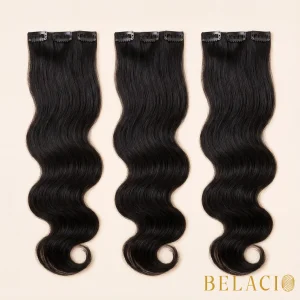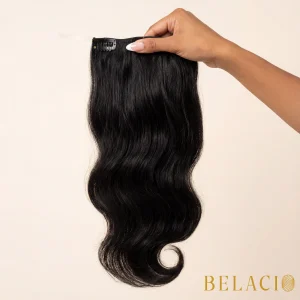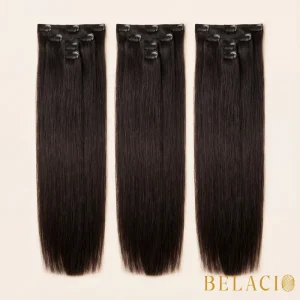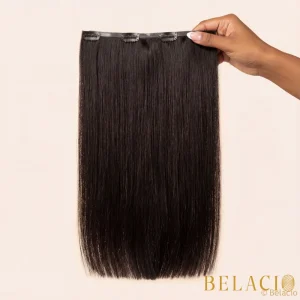

You’ve seen it happen: a client sits in your chair, excited about her new extensions, and within weeks she’s back—frustrated, embarrassed, with hair that tangled, shed, or looked thin before her first fill appointment. The supplier swore it was premium quality. The price suggested it should be. So what went wrong?
The answer often comes down to one specification that separates professional-grade extensions from disappointing ones: whether the hair is double-drawn or single-drawn. Understanding double-drawn vs single-drawn hair extensions isn’t just industry trivia—it’s the knowledge that determines whether your installations build your reputation or cost you clients.
The main difference between double-drawn and single-drawn extensions is strand length uniformity: double-drawn bundles contain 85-90% of strands at the same length from root to tip, while single-drawn retains the natural variation found in unprocessed hair with only 40-50% full-length strands. This processing difference affects everything from how many bundles you need to how long the installation lasts—and ultimately, whether your client returns happy.
What Does Double-Drawn Hair Mean and How Does It Differ from Single-Drawn?
Double-drawn hair is defined as hair that has undergone systematic sorting to remove shorter strands, resulting in 85-90% of fibers measuring within two inches of the target length. Single-drawn hair retains natural length variation, with roughly half the strands shorter than advertised. This isn’t about quality grades like virgin or Remy—it’s about processing methodology that dramatically affects density and performance.
Here’s where the terminology trips people up: “double-drawn” doesn’t mean the hair was stretched or pulled twice. The term refers to the sorting process—hair passes through quality control twice, with technicians manually removing shorter strands during each pass. Think of it as a refinement process, not a manipulation.
The double drawn hair meaning becomes clear when you understand the labor involved. Processing a single-drawn bundle takes 1-2 hours of professional work. Double-drawn? That same bundle requires 4-6 hours of meticulous hand-sorting. Technicians comb through raw bundles directionally, identify strands falling below the target length, and remove them individually. Then they repeat the entire process to catch what the first pass missed.
This labor intensity explains the 15-25% price premium for double-drawn over single-drawn products. You’re not paying for marketing—you’re paying for six times the processing labor per bundle.
Single drawn hair extensions quality serves a legitimate purpose, though. The natural taper mimics how hair actually grows from the scalp—mixed lengths creating a layered, graduated effect. For clients wanting subtle length or those with naturally fine hair, single-drawn can actually blend more seamlessly. The trade-off: shorter lifespan (typically 4-6 months versus 12-18 months for double-drawn) and thinner-looking ends that may disappoint clients expecting dramatic volume.
The key takeaway is this: double-drawn isn’t automatically “better”—it’s denser, fuller, and longer-lasting. Single-drawn isn’t “worse”—it’s more natural-looking, lighter, and budget-friendly. Your job is matching the right specification to each client’s goals.
How the Sorting Process Creates Quality Differences You Can See and Feel
The quality difference between double-drawn and single-drawn extensions comes from sequential manual sorting using traditional hackle methodology—a technique borrowed from centuries of wig-making. The visible quality marker professionals look for: ends that maintain the same thickness as roots rather than tapering to thin, sparse tips.
Here’s exactly what happens in a Vietnamese manufacturing facility during double-drawn processing:
Stage 1 – Initial collection: Raw donor hair arrives bundled with strands oriented root-to-tip but completely mixed in length. A single donor’s hair naturally grows at different rates across the scalp, so even virgin bundles contain significant length variation.
Stage 2 – Primary sorting: Technicians secure the bundle and comb it directionally using a hackle—a specialized tool with rows of metal pins that separates and aligns fibers. During this pass, they assess lengths and begin removing obvious short strands.
Stage 3 – Short strand removal: Here’s the labor-intensive part. Workers manually extract every strand falling more than two inches below target length. For an 18-inch bundle, that means removing anything under 16 inches. This step alone can take 2-3 hours per bundle.
Stage 4 – Secondary combing: The bundle passes through the hackle again, catching any remaining short strands that escaped first sorting. This “double” pass is where the name originates.
Stage 5 – Density verification: Quality control confirms uniform distribution from root to tip. The finished bundle should feel noticeably heavier for its length than single-drawn alternatives.
When you examine a properly double-drawn bundle, fan it out between your fingers. You should see consistent thickness throughout—no sparse sections, no wispy tips. The ends look almost blunt, like a fresh haircut rather than grown-out layers. Single-drawn bundles, by contrast, taper visibly toward the ends, with noticeable thinning in the last few inches.
Research consistently shows that this manual sorting process—while time-intensive—produces measurably superior density ratios that machine sorting cannot reliably replicate.
Density Comparison: Why Bundle Thickness Matters for Your Installation Results
The hair extension density comparison reveals why double-drawn changes your material calculations: you need 25-30% fewer bundles to achieve equivalent fullness. Double-drawn bundles maintain a density ratio 2-3x greater at the tips compared to single-drawn alternatives, meaning more actual hair throughout the length rather than concentrated at the roots.
Let me break down the math that affects your purchasing decisions.
A typical full-head installation requires 3-5 bundles depending on your client’s natural density and desired fullness. With single-drawn extensions, you’re usually working at the higher end of that range—4-5 bundles minimum—because the tapered ends create thinner coverage. Double-drawn installations often achieve the same visual fullness with 3-4 bundles.
Here’s what’s happening at the fiber level: industry analysis indicates that single-drawn bundles contain roughly 400-450 individual hair fibers of inconsistent thickness. Double-drawn extension bundles contain 330-380 fibers of uniform length. Super double-drawn (the premium tier with 95%+ uniformity) contains 280-320 fibers exclusively at maximum diameter specifications.
Fewer fibers doesn’t mean less hair. It means the fibers present are all full-length, contributing to visible density throughout rather than just at the root area. The cross-sectional area per bundle actually increases because there’s no “filler” from short strands that add weight without adding visible length.
Premium hair extension specifications at the double-drawn level translate directly to client value:
- Material efficiency: The same visual result requires fewer bundles, partially offsetting the per-bundle price premium
- Installation uniformity: Consistent strand lengths respond identically to heat, moisture, and styling—no sections behaving differently than others
- Longevity advantage: With all strands contributing to structure equally, there’s no early failure from thin areas wearing out first
- Blending consistency: Uniform ends create cleaner lines when cutting extensions to match client’s natural hair
The key takeaway is that wholesale hair quality markers include not just virgin status or cuticle alignment, but density specifications that directly impact how many bundles you order and how satisfied your clients remain months after installation.
Which Extension Type Performs Best in Caribbean Humidity and Tropical Climates
Climate performance depends on cuticle integrity rather than processing type—both double-drawn and single-drawn extensions perform excellently in Caribbean humidity when sourced as virgin hair with intact cuticle alignment. The real differentiator for Puerto Rico’s 75-85% year-round humidity isn’t density processing; it’s whether the hair’s protective structure remains undamaged.
Here’s the science that mainland suppliers rarely explain: human hair is hygroscopic, meaning it absorbs and releases moisture based on environmental humidity. According to peer-reviewed scientific research on human hair mechanical properties and moisture behavior, hair can absorb up to 30% of its weight in water—and actually gains tensile strength by up to 58% in wet conditions compared to dry.
In Caribbean climates, this moisture exchange happens constantly. The critical factor is how it happens:
Properly aligned cuticles (the overlapping scales covering each hair strand) regulate moisture absorption uniformly. Water enters and exits through controlled pathways, allowing the hair to swell slightly in humidity and contract as it dries—without structural damage. This is what happens with virgin Vietnamese hair that’s been correctly processed.
Damaged or misaligned cuticles allow chaotic moisture penetration. Water enters at random points, causing uneven swelling that leads to frizz, tangling, and premature breakdown. This happens with chemically processed hair, acid-bath treated hair, or bundles where cuticle direction was mixed during collection.
What does this mean for your purchasing decisions? A virgin single-drawn bundle with intact cuticles will outperform a chemically treated double-drawn bundle in tropical humidity every time. The processing method matters less than the hair’s fundamental integrity.
For salons serving Caribbean clients, look for these humidity-ready specifications regardless of density processing:
- Virgin status (zero chemical processing) with documentation
- Single-donor sourcing ensuring cuticle direction consistency
- Origin certificates from Vietnamese facilities with quality certifications
- Supplier guidance specific to tropical maintenance protocols
Double-drawn and single-drawn both perform—the humidity question is really a quality question.

Professional Quality Markers That Separate Premium Extensions from Inferior Product
Professionals should look for five verification tests that expose quality claims: the burn test for human hair authenticity, float test for processing history, wet tangle test for cuticle integrity, bleaching response test for virgin status, and visual density assessment for accurate double-drawn specifications. Beyond testing, documented certifications from facilities meeting ISO 9001:2015 quality management certification standards for manufacturing excellence provide supply chain accountability that verbal promises cannot.
Let’s walk through each test you can perform before committing to wholesale inventory:
Burn Test (Synthetic vs. Human Hair): Remove 5-10 strands from the weft and apply a direct flame. Human hair ignites with an orange flame, burns slowly with a distinctive protein smell (like burning feathers), and turns to fine ash that crumbles between your fingers. Synthetic fiber melts rather than burns, produces black smoke with a plastic odor, and leaves hard, sticky residue. This test takes 30 seconds and immediately exposes blended or synthetic products marketed as 100% human hair.
Float Test (Processing History): Drop a small strand sample into room-temperature water. Virgin hair with intact cuticles sinks gradually over 30-60 seconds as water penetrates the fiber structure. Heavily processed or silicone-coated hair floats indefinitely because surface treatments prevent water absorption. Hair that sinks immediately may have been acid-bath treated, stripping cuticles and creating excessive porosity.
Wet Tangle Test (Cuticle Integrity): Wash a sample with regular shampoo, agitate vigorously, rinse thoroughly, then attempt to comb through while wet. Premium quality hair combs through with minimal resistance and returns to smooth texture after drying. Severe tangling that resists detangling indicates reversed cuticles, cuticle damage, or mixed-direction strands that will only worsen with wear.
Bleaching Response Test (Virgin Status): Apply professional lightener to a strand sample following manufacturer instructions. Genuine virgin hair lifts evenly through color levels while maintaining structural integrity. Previously processed or dye-treated hair shows uneven lifting, unexpected orange or brassy tones, and rapid structural degradation—revealing prior chemical exposure that suppliers may not have disclosed.
Visual Density Assessment: Fan the bundle to evaluate uniformity. Double-drawn should show consistent thickness from root to tip with no sparse sections. Hold the bundle at various points along its length—weight distribution should feel even rather than concentrated at the roots.
Beyond testing, verify supplier credentials. Reputable Vietnamese manufacturers increasingly maintain ISO 9001:2015 certification for quality management and SA 8000:2014 for ethical sourcing practices. Ask for Certificates of Origin from the Vietnamese Chamber of Commerce documenting actual facility location—not just a country label.
One note on grading systems: the 6A through 13A scale you’ll see in marketing materials lacks standardization. One supplier’s 10A may equal another’s 8A because no independent body defines these grades. Testing and certification documentation matter far more than arbitrary letter-number combinations.
Making the Right Wholesale Investment: When to Choose Single-Drawn vs. Double-Drawn
When choosing between double-drawn and single-drawn for wholesale inventory, match the specification to your client outcomes: double-drawn delivers maximum volume and 12-18 month lifespan for dramatic transformations, while single-drawn provides natural-looking taper and 4-6 month wear for budget-conscious clients or subtle length additions. The 15-25% price premium for double-drawn justifies itself through longevity and material efficiency—but only when clients want the results it delivers.
Here’s a decision framework based on client goals:
Stock double-drawn for:
- Clients seeking dramatic volume and transformation
- Bridal, quinceañera, and special event installations where impact matters
- Clients with thick natural hair needing density match
- Premium positioning strategy where you’re building extension specialization reputation
- Any installation where longevity justifies higher upfront investment
Stock single-drawn for:
- Clients prioritizing natural-looking movement and subtle enhancement
- Budget-conscious clients willing to accept shorter wear cycles
- Very long installations (26″+) where slight tapering appears realistic
- Clients with fine natural hair where extreme density may not blend
- Entry-level extension services building client comfort with the category
The investment calculation: Consider total cost of ownership, not just per-bundle pricing. Double-drawn at a 20% premium that lasts 12-18 months actually costs less per month of wear than single-drawn lasting 4-6 months. For clients doing regular reapplication appointments, double-drawn’s durability creates better value despite higher initial cost.
Inventory strategy recommendation: Maintain both specifications to serve diverse client needs. Position double-drawn as your flagship premium offering with educated pricing that reflects the quality difference. Use single-drawn as an accessible entry point for clients testing extension services or working within tighter budgets.
The supplier verification process matters equally for both specifications. A well-made single-drawn bundle from a certified Vietnamese facility will outperform a poorly-made “double-drawn” bundle from an unverified source. Quality starts with sourcing integrity—processing type builds on that foundation.
Key Takeaways
In summary, here are the essential points every salon professional should remember:
- Double-drawn means 85-90% uniform strand length achieved through 4-6 hours of manual sorting per bundle, commanding 15-25% price premium over single-drawn’s 40-50% uniformity processed in 1-2 hours.
- You need 25-30% fewer double-drawn bundles to achieve equivalent fullness because the 2-3x greater tip density means all strands contribute to visible length rather than tapering to sparse ends.
- Caribbean humidity performance depends on cuticle integrity, not processing type—both double-drawn and single-drawn perform well when sourced as virgin hair with aligned cuticles that regulate moisture absorption uniformly.
- Five verification tests (burn, float, wet tangle, bleaching response, visual density) expose quality claims better than any supplier’s marketing, while ISO 9001:2015 certification provides documented supply chain accountability.
- Match specification to client goals: double-drawn for volume and longevity (12-18 months), single-drawn for natural taper and budget sensitivity (4-6 months)—both serve legitimate purposes in a well-rounded service menu.
Frequently Asked Questions
What does double-drawn hair actually mean?
Double-drawn hair refers to bundles processed through sequential manual sorting that removes shorter strands, resulting in 85-90% of fibers measuring uniform length from root to tip. The term comes from hair passing through quality control twice—not from stretching or pulling. This process requires 4-6 hours per bundle versus 1-2 hours for single-drawn.
How can I tell if extensions are truly double-drawn?
Fan the bundle between your fingers and look for consistent thickness throughout—ends should appear nearly as full as roots with no sparse sections. Weigh the bundle; double-drawn feels noticeably heavier for its length. The ends should look blunt, like a fresh haircut, rather than graduated like grown-out layers.
Is double-drawn hair better than single-drawn?
Not automatically—each serves different purposes. Double-drawn delivers maximum volume and 12-18 month lifespan, ideal for dramatic transformations. Single-drawn provides natural-looking taper and 4-6 month wear, better for subtle enhancement or blending with fine natural hair. The “better” choice depends on client goals.
Why does double-drawn cost more than single-drawn?
The price premium (typically 15-25%) reflects processing labor. Single-drawn requires 1-2 hours of basic sorting; double-drawn requires 4-6 hours of meticulous hand-sorting. Additionally, the sorting process removes 20-30% of raw material as waste, increasing cost per finished bundle.
Do double-drawn extensions work well in humid climates like Puerto Rico?
Yes—but so do single-drawn extensions. Climate performance depends on cuticle integrity rather than density processing. Virgin hair with properly aligned cuticles regulates moisture uniformly in 75-85% humidity, performing excellently regardless of processing type.
Building Your Extension Expertise: The Path Forward
The key takeaway is that understanding double-drawn vs single-drawn hair extensions transforms you from someone who orders extensions into someone who prescribes them with confidence. You’re no longer at the mercy of supplier claims—you can verify quality, match specifications to client needs, and justify premium pricing with education rather than promises.
This knowledge separates extension specialists from stylists who happen to offer extensions. When you can explain why double-drawn costs more and demonstrate the density difference clients will actually see, you’re building the kind of trust that creates waiting lists.
Explore sample bundles before committing to wholesale inventory. Perform the verification tests. Ask for documentation. The suppliers worth partnering with welcome that scrutiny—because they know their product can prove itself.