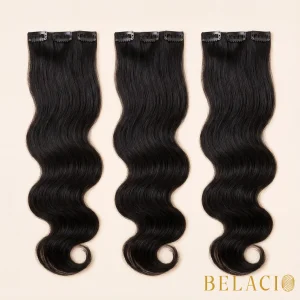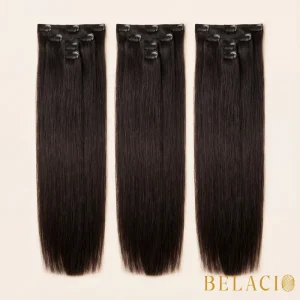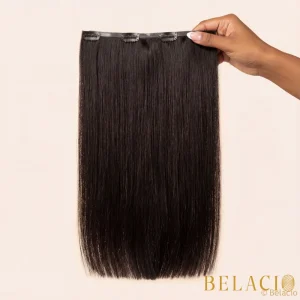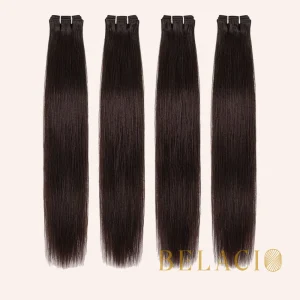
Wholesale clip-in hair extensions give salon owners the highest margin potential in the extensions category because clip-ins require zero installation labor, move fast as retail inventory, and work for walk-in customers who want same-day transformation. A typical boutique salon in Puerto Rico can achieve 50–70% margins on wholesale clip-ins when purchasing at the right volume tier — but only if you understand minimum order thresholds, realistic per-unit costs, and the markup math that actually works for Caribbean markets.
Key Takeaways
- Wholesale clip-in extensions typically require minimum orders of 1–15 bundles per SKU depending on the supplier tier, with micro-wholesale starting at just 1 bundle for independent stylists.
- Salon markup on wholesale clip-ins ranges from 2.5x to 3.5x the wholesale cost, producing gross margins of 50–70% depending on your volume tier.
- Factory-direct suppliers like Belacio eliminate the distributor middleman, which means your wholesale cost drops 15–25% compared to buying through a regional distributor.
- Clip-in extensions are the safest wholesale investment for new salon owners because unsold inventory doesn’t expire — human hair clip-ins have a 12–36 month shelf life with zero degradation when stored properly.
- Puerto Rico-based wholesale programs offer a logistics advantage over mainland suppliers: no customs delays, same US postal system, and 1–3 day delivery across the island.
- The ROI timeline for wholesale clip-in inventory is 60–90 days for a boutique salon carrying 3–5 SKUs, assuming 2–3 clip-in sales per week at standard Caribbean market pricing.
Why Do Salon Owners Buy Clip-In Extensions Wholesale?
Clip-in extensions are the fastest-turning wholesale product in the hair extension category because they require no professional installation, appeal to both walk-in and appointment clients, and generate revenue without tying up a stylist’s chair time. That combination of low labor cost and high customer demand makes clip-ins the ideal entry point for salons exploring wholesale hair inventory.
I learned this the hard way. When I first started testing wholesale inventory for Belacio, I ordered tape-ins and wefts expecting them to move quickly. They did — but only during installation appointments. The clip-ins? Those sold to women who walked in, tried the color match, and left with a full set in under 10 minutes. No booking. No stylist required. Pure retail margin.
For a salon owner in Puerto Rico, the economics are even more compelling. Our salon culture is built around relationships and walk-in traffic. A client who comes in for a blowout sees the clip-in display, asks to try a set, and walks out with $150–$180 in additional revenue that took zero chair time.
What Is the Minimum Order for Wholesale Clip-Ins?
Minimum order quantities (MOQs) for wholesale clip-in hair extensions range from 1 bundle per SKU for micro-wholesale tiers to 15+ bundles for elite distributor pricing. The right tier depends on your salon size, monthly client volume, and how much capital you can commit to initial inventory.
Here’s how typical wholesale tier structures break down for the Caribbean market:
| Wholesale Tier | MOQ (Bundles/SKU/Month) | Typical Discount Off Retail | Best For | Margin Potential |
|---|---|---|---|---|
| Micro | 1–2 | 25–30% | Independent stylist, 1–2 chairs | 40–50% |
| Core | 3–5 | 35–40% | Boutique salon, 3–8 chairs | 50–60% |
| Preferred | 6–10 | 42–45% | Multi-location, 20+ chairs | 60–70% |
| Elite | 15+ | 48–50% | Distributor, major chain | 70%+ |
Most boutique salons in Puerto Rico start at the Micro or Core tier. And here’s what nobody tells you — that’s perfectly fine. You don’t need to order 50 bundles to make wholesale work. Starting with 3–5 bundles across your two best-selling lengths (18″ and 22″ are the most popular in the Caribbean market) lets you test demand without overcommitting.
How Much Do Wholesale Clip-In Extensions Actually Cost?
At wholesale pricing, human hair clip-in extensions typically cost $70–$130 per full-head set depending on hair quality, length, and processing level. That’s 25–50% less than retail pricing, which means your cost-per-unit drops significantly even at the lowest volume tier.
Let me walk you through a real pricing chain so you can see exactly where the margin lives:
| Stage | Cost (18″ Vietnamese Human Hair, Full Set) |
|---|---|
| Factory cost (Vietnam) | $45–$65 |
| Wholesale to salon (factory-direct) | $70–$100 |
| Wholesale to salon (through distributor) | $90–$130 |
| Salon retail price | $150–$250 |
| Your gross margin (factory-direct) | $50–$150 per set |
The difference between factory-direct and distributor pricing is where most salon owners leave money on the table. A distributor adds 1.5–2x markup before the hair reaches your salon. When you buy directly from a manufacturer like Belacio — with a Puerto Rico warehouse and no customs middleman — you capture that distributor margin yourself.
That’s not a small number. On a monthly wholesale order of 10 full-head clip-in sets, the factory-direct savings versus distributor pricing is typically $200–$300 per month. Over a year, that’s $2,400–$3,600 back in your pocket.
What Markup Should Salons Use on Wholesale Clip-Ins?
The standard salon markup on wholesale clip-in hair extensions is 2.5x to 3.5x the wholesale cost, with most Caribbean boutique salons landing at 2.8x–3.0x for optimal competitiveness and profitability. This produces a gross margin of 60–70% — significantly higher than the typical salon service margin of 35–45%.
Here’s the markup math for a real scenario:
Your wholesale cost for an 18″ straight clip-in set (double-drawn, 100% Vietnamese human hair): $85. At a 2.8x markup, your retail price is $238. Your gross profit per set is $153.
Now multiply that by the 8–12 clip-in sets a well-stocked boutique salon sells per month in Puerto Rico. That’s $1,224–$1,836 in monthly gross profit from clip-ins alone — and none of it required chair time.
The key is finding the markup sweet spot for your specific market. In San Juan metro areas, clients expect to pay $180–$250 for a quality human hair clip-in set. In smaller towns across the island, $150–$200 is the competitive range. Price too high and you lose walk-in impulse buyers. Price too low and you’re leaving margin on the table.
How Long Does Wholesale Clip-In Inventory Take to Pay for Itself?
A boutique salon carrying 3–5 clip-in SKUs typically reaches full ROI on initial wholesale inventory within 60–90 days, assuming 2–3 clip-in sales per week at standard Caribbean market pricing. This makes clip-ins the fastest-payback wholesale investment in the extensions category.
Let me break down a realistic scenario for a 4-chair salon in Puerto Rico:
Initial investment: 15 full-head sets across 3 SKUs (straight 18″, straight 22″, soft wavy 18″) at Core tier pricing = approximately $1,275.
At 2–3 sales per week with an average retail price of $200 and a gross margin of approximately $115 per set, you generate $230–$345 in weekly gross profit. Your initial investment pays for itself in 4–6 weeks.
After that? Every clip-in sale is pure profit minus your reorder cost. And here’s the part I love about clip-ins specifically — unsold inventory doesn’t expire. Human hair extensions stored in a cool, dry environment maintain their quality for 12–36 months. No spoilage. No seasonal markdowns. No waste.
What Makes a Wholesale Supplier Worth Your Business?
The three factors that separate a reliable wholesale hair extension supplier from a risky one are sourcing transparency, minimum order flexibility, and post-purchase support — not just the lowest price. I’ve seen too many salon owners chase the cheapest wholesale quote and end up with hair that tangles after two washes.
When evaluating wholesale clip-in suppliers, ask these questions:
- Where does the hair actually come from? A real supplier can tell you the country of origin and processing method. “100% human hair” without origin details is a red flag.
- What’s the MOQ flexibility? Suppliers who demand 50+ units per color are optimized for distributors, not boutique salons. Look for programs that start at 1–5 bundles per SKU.
- Is the payment upfront or net-30? In the Caribbean wholesale market, upfront payment is standard. Net-30 terms sound appealing but often indicate larger, less flexible operations.
- What happens when a client complains? Post-purchase support matters more than initial pricing. A supplier who helps you troubleshoot a client issue protects your salon’s reputation.
For Puerto Rico specifically, there’s another critical factor: logistics. Buying from a PR-based wholesaler means 1–3 day delivery, no customs clearance, and the same US postal system you already use. Ordering from overseas factories means 15–45 days for sea freight, customs paperwork, and the risk of delays that leave you without inventory during peak season.
How Do Clip-Ins Compare to Other Extension Types for Wholesale?
Clip-in extensions offer the highest wholesale margin potential with the lowest operational complexity because they require zero professional installation, have the broadest customer base, and generate pure retail revenue without consuming chair time. For salon owners evaluating which extension type to stock first, clip-ins are the safest bet.
| Factor | Clip-In (Wholesale) | Tape-In (Wholesale) | Weft (Wholesale) |
|---|---|---|---|
| Installation required | No (DIY) | Yes (professional) | Yes (professional) |
| Chair time per client | 0 minutes | 45–90 minutes | 60–120 minutes |
| Revenue type | Pure retail | Service + product | Service + product |
| Client base | Walk-in + appointment | Appointment only | Appointment only |
| Shelf life | 12–36 months | 12–36 months | 12–36 months |
| Average retail price (PR) | $150–$250 | $200–$350 (hair only) | $180–$300 (hair only) |
| Gross margin range | 50–70% | 40–60% | 40–60% |
| Inventory risk | Low (no expiry) | Low (no expiry) | Low (no expiry) |
The data is clear. Clip-ins win on margin, simplicity, and client accessibility. That doesn’t mean tape-ins and wefts aren’t profitable — they absolutely are, especially when you bundle installation service fees. But if you’re building wholesale inventory for the first time, start with clip-ins. Scale into semi-permanent types once you have the client base and stylist availability to support installation appointments.
How to Start Your First Wholesale Clip-In Order
Start your first wholesale clip-in order with 3 SKUs in your salon’s most-requested lengths and textures, at the lowest available tier, to validate demand before scaling up. You don’t need to stock every color and length on day one.
Here’s the step-by-step approach that works for Caribbean salons:
- Identify your top 2 lengths. For most Puerto Rico salons, that’s 18″ (everyday length) and 22″ (event/glam length).
- Choose your primary texture. Straight clip-ins sell fastest as everyday inventory. Add soft wavy if your clientele trends toward natural texture blending.
- Start at the Micro or Core tier. Order 3–5 full-head sets per SKU. Total investment: $500–$1,000.
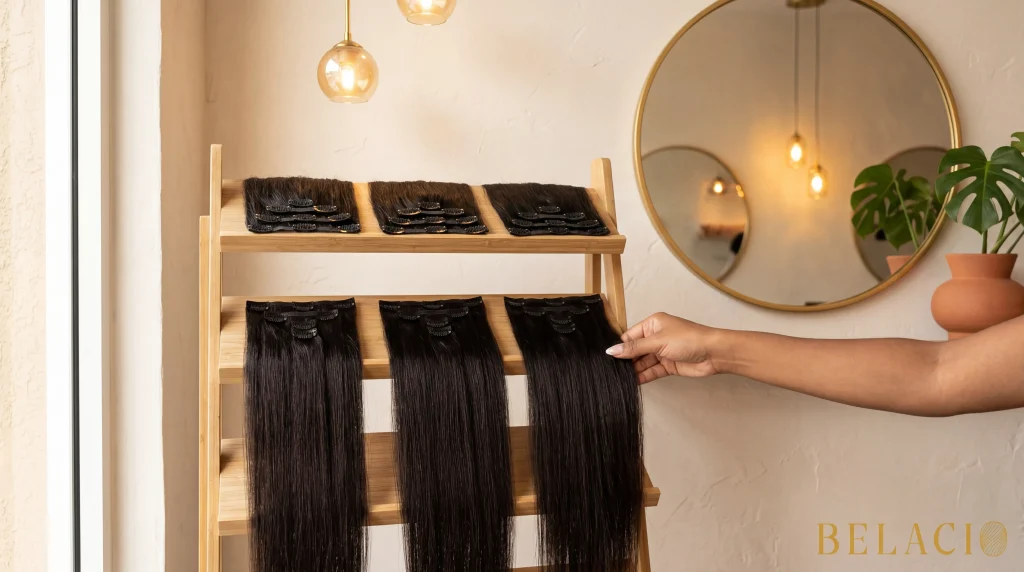
- Display prominently. Clip-ins sell best when clients can see and touch them. A simple countertop display near checkout converts walk-in curiosity into impulse purchases.
- Track what sells. After 60 days, you’ll know which lengths and textures your clients prefer. Reorder those. Drop what doesn’t move.
- Scale into the next tier when your monthly reorder volume consistently exceeds the Core tier MOQ.
If you’re a salon owner in Puerto Rico looking at wholesale clip-in extensions, I’d love to walk you through Belacio’s wholesale program personally. We built it specifically for Caribbean boutique salons — flexible MOQs, factory-direct pricing with no distributor markup, and 1–3 day delivery anywhere on the island. Send me a message on WhatsApp at 787-671-7122 and let’s talk about what makes sense for your salon.
Preguntas Frecuentes
What is the minimum order for wholesale clip-in hair extensions?
Minimum orders for wholesale clip-in extensions range from 1–2 bundles per SKU at micro-wholesale tiers to 15+ bundles for elite distributor pricing. Most boutique salons start at the Core tier with 3–5 bundles per SKU per month.
How much markup should salons charge on wholesale clip-ins?
The standard salon markup on wholesale clip-in extensions is 2.5x to 3.5x the wholesale cost. For Caribbean markets, 2.8x–3.0x produces the best balance of competitiveness and profitability, yielding gross margins of 60–70%.
Are wholesale clip-in extensions profitable for small salons?
Yes. A boutique salon selling 2–3 wholesale clip-in sets per week at standard Caribbean pricing generates $920–$1,380 in monthly gross profit. Initial wholesale inventory investment typically pays for itself within 60–90 days.
How long do unsold wholesale clip-in extensions last in storage?
Human hair clip-in extensions stored in a cool, dry environment maintain their quality for 12–36 months with zero degradation. This makes clip-ins a low-risk wholesale investment since unsold inventory doesn’t expire or lose value.
What should I look for in a wholesale clip-in supplier?
Evaluate wholesale suppliers on four factors: sourcing transparency (country of origin and processing method), minimum order flexibility (1–5 bundle minimums for boutique salons), payment terms, and post-purchase support quality. For Puerto Rico salons, local warehousing with 1–3 day delivery is a significant advantage.
Is factory-direct wholesale cheaper than buying through a distributor?
Factory-direct wholesale pricing is typically 15–25% lower than distributor pricing because it eliminates the intermediary markup. On a monthly order of 10 clip-in sets, the savings versus distributor pricing is approximately $200–$300 per month.
Do I need a business license to buy wholesale clip-in extensions?
Most wholesale clip-in suppliers require proof of business registration or a salon license to access wholesale pricing tiers. Requirements vary by supplier — some accept independent stylist credentials while others require a registered salon business.
Tu Próximo Paso
You now have the numbers, the tier structure, and the markup math to make a smart wholesale decision for your salon. The clip-in category is the lowest-risk, highest-margin entry point into wholesale hair inventory — and in Puerto Rico, the logistics advantage of buying from a local supplier makes the math even better.
Your clients are already asking about clip-ins. Now you can stock them, price them right, and keep the margin that used to go to distributors.
Ready to see wholesale pricing for your salon? Message Natalia directly on WhatsApp at 787-671-7122 or visit Belacio’s wholesale page to explore the program. If you’re already stocking extensions and want to compare what you’re paying, bring your current invoices — I’ll show you exactly where the savings are.