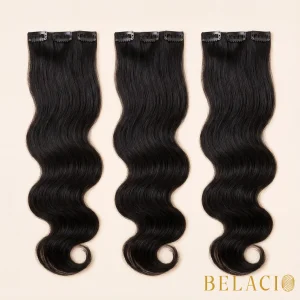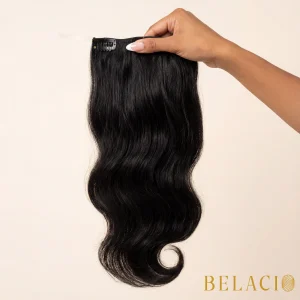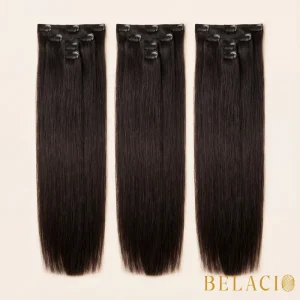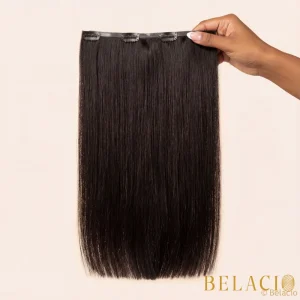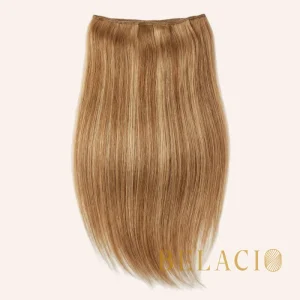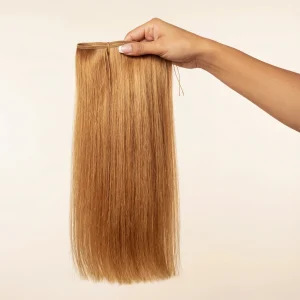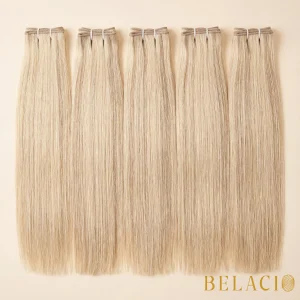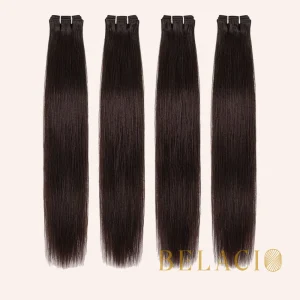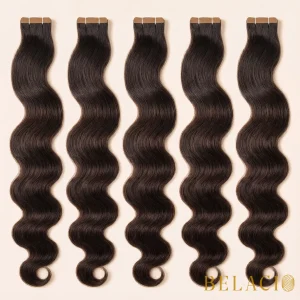

Stocking human bulk hair and extension inventory strategically transforms salon profitability from unpredictable service-by-service revenue to a recurring wholesale model with 50-70% gross margins. The smartest salon owners in Puerto Rico and the Caribbean buy hair in bulk bundles at 25-50% below retail, maintain 2-3 weeks of backup inventory per SKU, and generate predictable maintenance revenue every 6-8 weeks from each active extension client.
Key Takeaways
- Bulk Pricing Advantage: Purchasing human bulk hair and extensions at wholesale pricing (25-50% discount off retail depending on tier) creates margin room that funds both competitive client pricing and salon profit simultaneously.
- Inventory Sweet Spot: A 3-8 chair boutique salon in Puerto Rico needs 3-5 bundles per top-selling SKU per month to avoid stockouts, which translates to roughly $600-$1,200 in monthly hair inventory investment.
- Maintenance Revenue Cycle: Each extension client returns every 6-8 weeks for maintenance, generating $150-$250 per visit in recurring revenue that compounds as your active client base grows from 8 to 25 clients over 12 months.
- Texture Stocking Priority: In the Caribbean market, 1B natural black in straight and body wave textures account for 60-70% of salon extension demand, so stock these first and deepest before expanding to specialty colors and curl patterns.
- Wholesale Tier Economics: Moving from Micro tier (1-2 bundles/month, 25-30% discount) to Core tier (3-5 bundles/month, 35-40% discount) adds 10-15 percentage points to your gross margin on every installation.
- Climate-Tested Sourcing: Vietnamese single-donor hair with cuticle alignment is the safest wholesale investment for Caribbean salons because it survives 75-85% humidity without the silicone degradation that generates returns and client complaints with cheaper alternatives.
Why Should Salon Owners Buy Human Bulk Hair in Wholesale Quantities?
Salon owners who purchase human bulk hair and extensions at wholesale volume pricing earn 50-70% gross margins on installation services compared to 30-35% margins when buying retail. The economics are straightforward: buying hair in bulk bundles at 25-50% below retail creates a cost basis low enough to price installations competitively while still generating $350-$500 profit per full head service.
I see this calculation change lives every month. A salon owner in Bayamon was buying tape-in hair one pack at a time from a retail beauty supply store, paying $95-$115 per bundle. Her installation price had to be $500 just to cover costs and make a thin margin. When she switched to wholesale ordering at 35-40% below retail, her cost per bundle dropped to $60-$75. Same $500 installation. Double the profit. She went from one extension client per week to four because she could finally afford to market the service.
The math scales. A mid-market salon running 8-10 extension clients per month at wholesale pricing generates $13,000-$18,000 in annual gross profit from extensions alone. That’s before factoring in maintenance visits, care product sales, and referral growth. And the foundation of all of it is buying hair in bulk rather than retail.
What Are the 5 Smartest Ways to Build Salon Extension Inventory?
The five most effective inventory strategies for salon extension stocking are: starting with your top 3 SKUs rather than a full catalog, buying at the wholesale tier that matches your current volume, timing orders to your maintenance cycle calendar, investing in climate-tested hair that minimizes returns, and building a care product bundle that attaches to every installation.
1. Start with Your Top 3 SKUs, Not a Full Catalog
Stock 1B natural black in straight, body wave, and soft wavy textures first. These three cover 60-70% of Caribbean extension demand. Buying 3-5 bundles of each per month at wholesale pricing costs approximately $540-$1,125 depending on length and processing level. You can expand into specialty colors (blonde, dark brown, balayage) and additional textures (curly, kinky straight) after your core SKUs are moving consistently.
The mistake I see new salon owners make is ordering one bundle of everything. Six colors, four textures, three lengths. They spread $2,000 across 30 SKUs and have zero depth in any of them. The first time a client walks in wanting 22-inch straight 1B (the most popular request), they’re out of stock. Stock deep on a few rather than shallow on many.
2. Match Your Wholesale Tier to Your Actual Volume
Wholesale pricing tiers reward consistency, not one-time large orders. Here’s how the tier structure works for most premium hair extension suppliers:
| Wholesale Tier | Monthly Volume | Discount Off Retail | Best For | Estimated Monthly Spend |
|---|---|---|---|---|
| Micro | 1-2 bundles/SKU | 25-30% | Independent stylists, 1-2 chairs | $200-$500 |
| Core | 3-5 bundles/SKU | 35-40% | Boutique salons, 3-8 chairs | $600-$1,500 |
| Preferred | 6-10 bundles/SKU | 42-45% | Multi-location, 20+ chairs | $1,500-$3,500 |
| Elite | 15+ bundles/SKU | 48-50% | Distributors, regional chains | $4,000+ |
Don’t overcommit to a higher tier than your current client flow supports. Start at Micro or Core, track your sell-through rate for 3 months, and upgrade tiers naturally as your active extension client base grows. Jumping to Preferred before you have the client volume to support it ties up cash in inventory that sits on your shelf losing its freshness signal.
3. Time Your Orders to Your Maintenance Calendar
Extensions generate a recurring revenue cycle. Weft installations last 6-8 weeks before the client needs a maintenance visit (tightening, reapplication, or new hair). Tape-in extensions need reapplication every 6-8 weeks. Build a simple spreadsheet tracking each client’s install date and predicted return date. Then order inventory 2 weeks before your maintenance surge.
Here’s how this works in practice for a salon with 15 active extension clients:
| Month | New Installs | Maintenance Returns | Hair Needed | Revenue |
|---|---|---|---|---|
| Month 1-3 | 3-4/month | 0 (pipeline building) | 6-8 bundles | $4,500-$6,000 |
| Month 4-6 | 2-3/month | 3-4/month (first wave returns) | 8-12 bundles | $7,500-$10,500 |
| Month 7-12 | 2-3/month | 7-8/month (full pipeline) | 10-15 bundles | $10,500-$14,400 |
The revenue compounds because you’re earning from both new installations and maintenance. By month 7, maintenance revenue from existing clients exceeds new installation revenue. This is where stocking backup human bulk hair becomes critical. Running out of inventory during a maintenance cycle means losing a client who has already proven they’ll come back.
4. Source Climate-Tested Hair to Minimize Returns
The number one inventory cost drain for Caribbean salons is returns from hair that can’t handle tropical humidity. Salon owners who stock cheap, silicone-coated bulk hair extensions watch their margins evaporate when clients come back at week 3 complaining about frizz, tangling, and shedding.
Vietnamese single-donor hair with cuticle alignment is the safest bulk hair investment for Caribbean salons because the intact cuticle scales create a natural moisture barrier. I’ve tested this across every origin on the market. Indian processed hair starts frizzing after 5-10 washes as the silicone coating strips away. Chinese blended hair tangles within weeks. Vietnamese Remy hair with aligned cuticles holds its style through months of 75-85% humidity.
The upfront cost is higher. Vietnamese premium bulk hair costs $100-$195 per bundle at retail, compared to $30-$80 for mixed-origin alternatives. But when you factor in zero returns, zero replacement costs, and clients who rebook because their hair still looks incredible at week 8, the per-client profitability of premium hair outperforms budget hair by 40-60%.
5. Bundle Care Products with Every Installation
Every extension installation should include a care product recommendation. Sulfate-free shampoo, conditioning treatments, heat protectant, and silk pillowcase recommendations create a secondary revenue stream that adds 15-20% to each transaction. More importantly, proper care extends the life of the extensions, which protects your reputation and generates the word-of-mouth referrals that fill your calendar.
The attachment rate in successful Caribbean salons runs 35-40% of extension clients purchasing at least one care product at the time of installation. At $50-$100 per care bundle, that’s an additional $200-$400 per month for a salon with 8-10 active extension clients. Stock the care products alongside your hair inventory and present them as part of the service, not an upsell.
How Do You Calculate ROI on Wholesale Extension Inventory?
A salon investing $7,200 in wholesale hair inventory over 12 months can expect $18,000 in installation revenue, $4,800 in maintenance revenue, and $2,400 in care product sales for a first-year gross profit of approximately $13,800 (65% margin). This ROI assumes starting at the Core wholesale tier with 15-20 active extension clients by month 7.
The calculation breaks down by service type:
| Revenue Source | Year 1 Estimate | Margin | Gross Profit |
|---|---|---|---|
| New installations (25-30 clients) | $15,000-$18,000 | 55-60% | $8,250-$10,800 |
| Maintenance/reapplication | $4,800-$6,000 | 65-75% | $3,120-$4,500 |
| Care product attach | $2,000-$2,400 | 60-70% | $1,200-$1,680 |
| Total Year 1 | $21,800-$26,400 | 58-65% | $12,570-$16,980 |
What makes this model sustainable is that Year 2 starts with the client base you built in Year 1. You’re not starting from zero. Those 15-20 clients who started their maintenance cycles continue returning, and your referral velocity increases as satisfied clients share results on Instagram and TikTok.
What Types of Bulk Hair Extensions Should Salons Stock First?
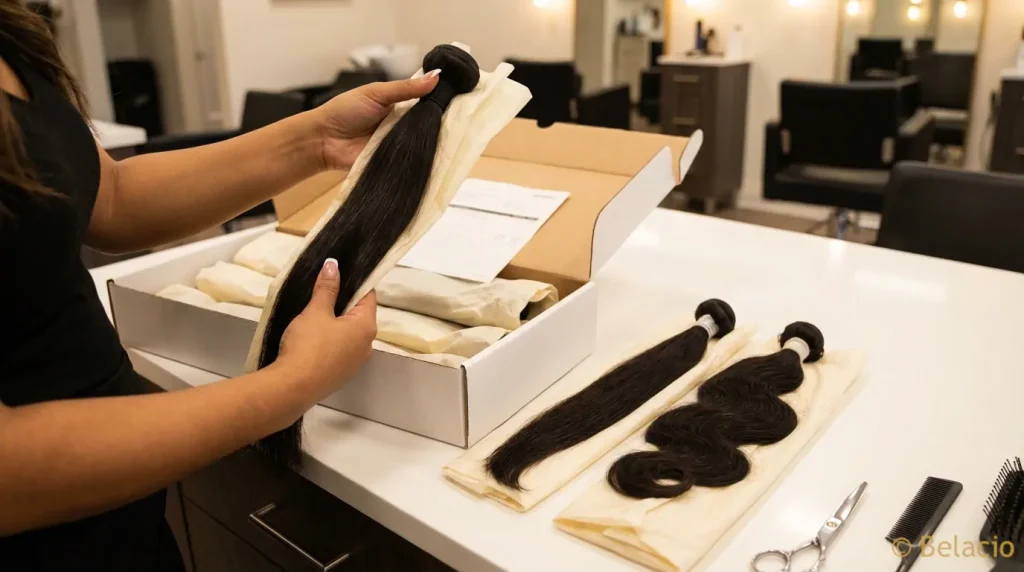
Salons in the Caribbean market should prioritize stocking 1B natural black human bulk hair in straight and body wave textures across 16-inch to 22-inch lengths, which covers the highest-demand client requests. These two texture-color combinations account for 60-70% of extension installations in Puerto Rico and Dominican Republic salons.
Here’s the stocking priority framework:
- Tier 1 (Stock immediately): 1B straight weft and 1B body wave weft in 16″, 18″, 20″, and 22″ lengths. These are your bread and butter. Never run out.
- Tier 2 (Add after month 3): 1B soft wavy and 1B curly textures. Natural texture demand is rising in the Caribbean, and these textures blend beautifully with Dominican and Puerto Rican natural hair patterns.
- Tier 3 (Add after month 6): Dark brown, blonde (#613), and balayage options. Color requests increase once your salon establishes a reputation for quality extensions. Stock these in 2-3 lengths each.
- Tier 4 (Specialty/on-order): Clip-in sets for clients who want temporary options, caramel blonde for the summer season, and custom lengths (24″+).
For each tier, maintain enough bulk hair inventory to cover 2-3 weeks of client demand. That’s typically 3-5 bundles per top SKU for a boutique salon. Check the Belacio wholesale program for current tier pricing and minimum order details.
How Does Caribbean Climate Affect Your Inventory Decisions?
Tropical humidity at 75-85% dictates which hair origins, textures, and processing levels perform well enough to stock at wholesale volume, because hair that fails in Caribbean climate generates returns, unhappy clients, and damaged salon reputation. Vietnamese hair with intact cuticle alignment is the climate-safe choice. Hair with stripped cuticles coated in silicone degrades within weeks in these conditions.
This matters more for wholesale than retail because you’re making a larger financial commitment. Stocking 20 bundles of hair that can’t handle your local climate means 20 bundles of potential returns. I learned this lesson early. The first batch of bulk hair I ordered for salon clients was beautifully packaged Chinese blended hair at an incredible per-bundle price. Within a month, three clients came back with tangled, frizzy hair that looked nothing like the day I installed it. I ate the replacement cost on every single one.
Since switching to Vietnamese single-donor sourcing for Belacio’s full product line, I haven’t replaced a single bundle for climate failure. The cuticle-aligned structure resists humidity-induced swelling. The hair behaves like healthy natural hair in moisture, not like processed fiber losing its coating. That reliability is what makes wholesale stocking viable for Caribbean salons.
What Mistakes Do New Salon Owners Make When Buying Bulk Hair?
The three most expensive mistakes new salon owners make when stocking human bulk hair are: over-ordering specialty colors before establishing core demand, choosing suppliers based solely on per-bundle price rather than total cost of ownership (including returns and replacements), and failing to track inventory turn rates which leads to dead stock.
I talk to salon owners across Puerto Rico every week, and these patterns repeat:
- Price-first sourcing. A salon owner finds bulk hair at $30 per bundle on a marketplace and orders 30 units. The hair looks good in the package. But after 3 installations, clients report tangling and shedding. The salon owner now has 27 bundles of unsellable inventory and has lost 3 clients. The true cost per bundle isn’t $30. It’s $30 plus the lost revenue from those 3 clients who won’t come back.
- No inventory tracking. Without tracking which SKUs sell fastest, salon owners reorder the wrong proportions. They end up with 10 bundles of 24-inch blonde (moves one per month) and zero bundles of 18-inch 1B straight (sells three per week). A simple spreadsheet with columns for SKU, quantity in stock, units sold per month, and reorder date prevents this entirely.
- Ignoring seasonal demand patterns. In the Caribbean, extension demand spikes before carnival season (February-March), summer (May-June), holiday season (November-December), and wedding season (varies by island). Plan your bulk hair purchases 4-6 weeks before each peak to ensure you have inventory when demand surges.
Preguntas Frecuentes
What is human bulk hair used for in salons?
Human bulk hair is loose hair without wefts, primarily used for braiding, crochet installations, locs, and custom wig-making. Salons also use the term “bulk purchasing” to describe buying wefted or tape-in extensions in wholesale quantities for stocking inventory.
How much does wholesale bulk hair cost per bundle?
Wholesale bulk hair pricing ranges from $30-$80 per bundle for mixed-origin blends to $100-$195 per bundle for Vietnamese single-donor premium hair. Wholesale tiers offer 25-50% discounts off retail pricing depending on monthly order volume.
How many bundles of hair should a salon keep in stock?
A boutique salon (3-8 chairs) should maintain 3-5 bundles per top-selling SKU, covering approximately 2-3 weeks of client demand. This translates to 15-30 total bundles across your core textures and lengths at any given time.
Can human bulk hair and extensions be dyed or bleached?
Vietnamese Remy human hair accepts color processing including darkening, toning, and balayage techniques. Lightening with bleach requires professional handling to protect the cuticle structure. Synthetic and non-Remy hair cannot be safely colored.
What is the difference between bulk hair and wefted extensions?
Bulk hair is loose, unwefted human hair sold by weight, used for braiding, crochet, and handmade extensions. Wefted extensions have hair sewn onto a fabric or silicone strip with clips, tape, or sew-in attachment methods. Both can be purchased in wholesale quantities.
How long does bulk human hair last with proper care?
Premium Vietnamese Remy bulk hair lasts 12-36 months depending on care, installation method, and climate exposure. Budget mixed-origin bulk hair typically lasts 3-6 months. Proper care includes sulfate-free washing, conditioning, and protection from salt water and chlorine.
Where can salons purchase wholesale hair extensions in Puerto Rico?
Puerto Rico-based salons can order wholesale extensions from Belacio Hair with same-territory USPS shipping (no customs), tiered wholesale pricing, and Spanish-language support. Orders placed by Friday deliver by Tuesday for metro area salons.
Your Next Step
You now have the five-strategy framework for building a salon extension inventory that generates consistent margins without tying up unnecessary capital. The formula is simple: stock your top 3 SKUs deep, buy at the wholesale tier matching your current volume, time orders to your maintenance calendar, source climate-tested hair, and bundle care products with every installation.
If you’re a salon owner in Puerto Rico or the Caribbean looking to start or scale your extension services with Vietnamese single-donor hair, explore the Belacio wholesale program for current tier pricing and minimum order details. Have questions about which products to stock first? Text me on WhatsApp at 787-671-7122 and I’ll help you build your initial order based on your salon size and client mix.