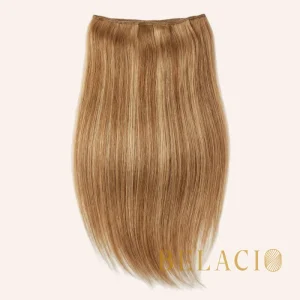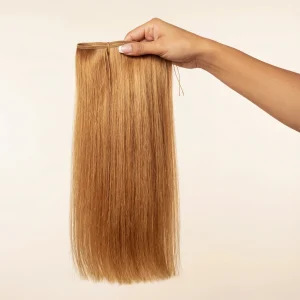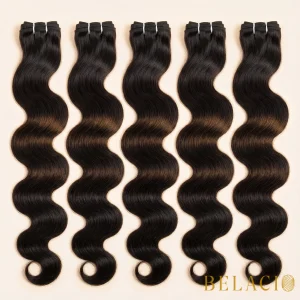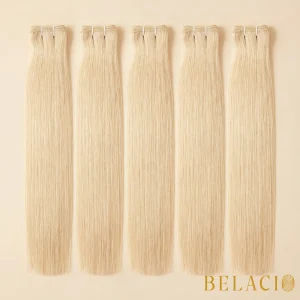
I spent three weeks visiting factories in Vietnam before I understood what actually separates a $60 weft from a $195 one. It’s not the label. It’s not even the packaging. It’s what happens to the hair before it ever gets sewn onto that thread — the sorting, the grading, the construction. And here’s the thing: most brands don’t want you to know this, because once you understand weft hair grades, you’ll never overpay for thin ends again.
This guide breaks down everything a stylist or first-time buyer needs to know about weft hair extensions — from the three processing grades that actually matter (forget the “12A” marketing nonsense) to the construction methods that determine how long your investment lasts. I’m sharing what I learned at the factory floor, not what I read on someone’s product page.
What Is a Weft and How Is It Constructed?
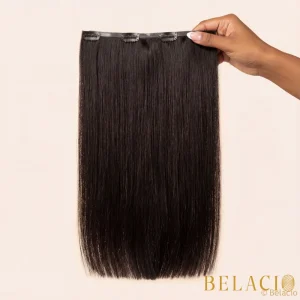
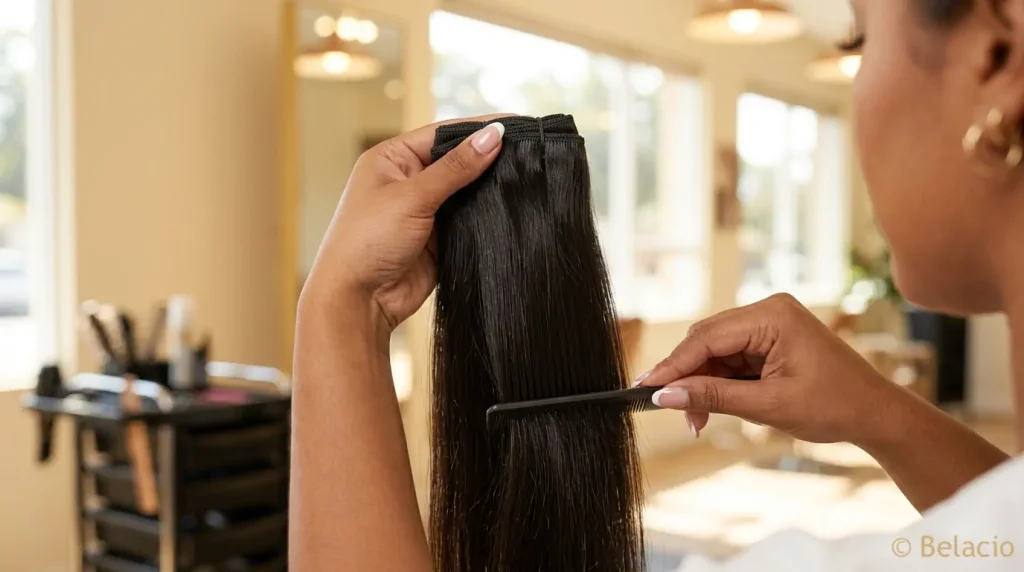
A weft is a continuous strip of human hair mechanically or hand-sewn onto a reinforced thread base, creating a flat track designed for professional sew-in installation. The thread base — typically polyester or nylon, 0.5–1.5mm in diameter — serves as the load-bearing foundation during wear, distributing tension evenly across the scalp.
Machine-sewn wefts use industrial stitching equipment operating at calibrated tension settings (7–9 on a 0–10 scale) with stitch widths of 2.0–2.5mm. A single operator can complete 50–100 individual weft sections daily. Hand-tied wefts, by comparison, produce only 3–8 sections per day — that labor difference is the reason hand-tied costs more, not some magical quality leap.
The construction matters for durability. Single-stitched wefts handle 1–2 installation cycles before the thread starts breaking down. Double-stitched — the industry standard for professional salon work — supports 2–3 cycles. Triple-stitched wefts, which is what we use at Belacio, handle 3–4 cycles under standard care conditions. That’s the difference between six months of use and two full years.
What Is the Difference Between Machine Weft and Hand-Tied Weft?
Machine weft extensions use industrial sewing equipment to stitch hair onto a reinforced thread base, producing a slightly thicker track (2–5mm) with exceptional durability and consistency across every section. Hand-tied wefts are knotted individually by hand, creating a thinner, more flexible track that lies flatter against the scalp.
Here’s the honest comparison:
| Feature | Machine Weft | Hand-Tied Weft |
|---|---|---|
| Track thickness | 2–5mm | 1–2mm |
| Durability | 3–4 installation cycles | 2–3 installation cycles |
| Production speed | 50–100 sections/day | 3–8 sections/day |
| Price range | $100–$195/bundle | $180–$350/bundle |
| Best for | Maximum volume, sew-in installs | Flat-lying, beaded row methods |
| Cut-ability | Can be cut and sealed | Cannot be cut without unraveling |
Neither method is objectively “better.” Machine wefts win on durability, consistency, and value. Hand-tied wefts win on flexibility and how flat they sit. Your installation method determines which one makes sense — sew-in work favors machine wefts, while beaded row techniques typically use hand-tied.
When I first started sourcing, I assumed hand-tied automatically meant premium. It doesn’t. What matters is the hair quality inside the weft, not just how it’s attached to the thread.
Why Do Hair Grades Matter More Than Brand Names?
The processing grade of weft hair — single drawn, double drawn, or super double drawn — determines the density, uniformity, and lifespan of your extensions more than any brand name or “A” rating ever will. This is the single most important thing to understand before you spend a dollar.
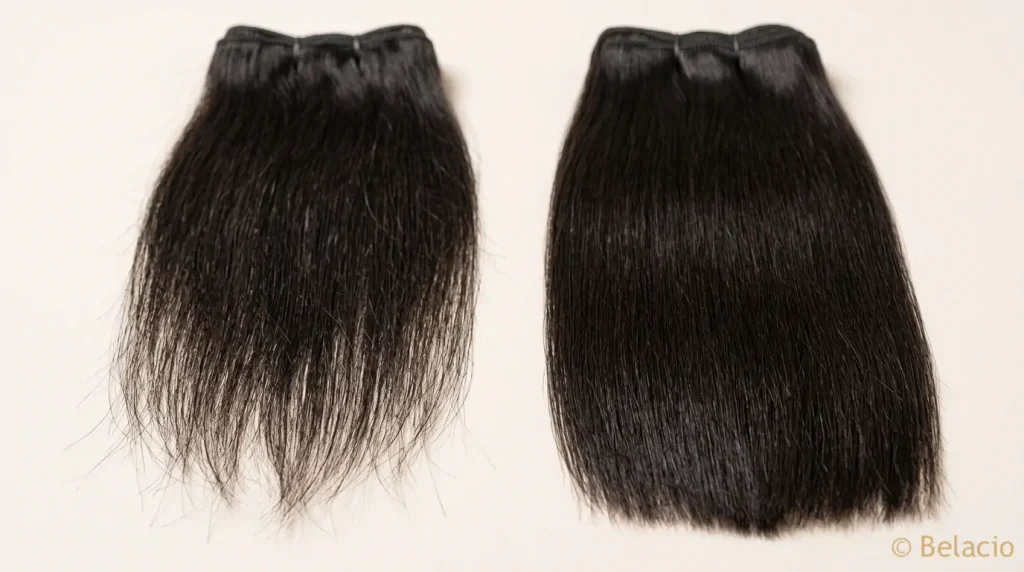
Single drawn hair contains 50–70% of strands at the advertised full length. The rest? Shorter hairs of varying lengths, creating a natural taper — thicker at the roots, thinner toward the ends. It’s the entry-level grade. It looks fine for the first month. After that, the thin ends start showing.
Double drawn hair undergoes manual sorting that removes shorter strands, yielding 70–90% uniform length throughout the bundle. The labor-intensive process wastes approximately 25% of the raw material — you start with 200 grams and end with 150 grams of double drawn output. That material loss is why double drawn commands a 15–25% price premium. But the result is unmistakable: consistent thickness from root to tip.
Super double drawn takes it further with a secondary diameter-based filtering stage. Not only are short strands removed, but thinner-diameter fibers get sorted out too. The result is 90–95%+ of strands at full length and maximum thickness — 280–320 fibers exclusively of the thickest diameter (90–120 micrometers). The yield loss hits 15–25% of raw bundle weight during this stage alone, which is why super double drawn runs 30–50% more than standard double drawn.
| Grade | Full-Length % | End Density | Typical Lifespan | Cost Premium |
|---|---|---|---|---|
| Single Drawn | 50–70% | Tapered, thin ends | 4–6 months | Baseline |
| Double Drawn | 70–90% | Uniform thickness | 12–18 months | +15–25% |
| Super Double Drawn | 90–95%+ | Maximum fullness | 18–24+ months | +30–50% |
And here’s the thing nobody talks about: the “A” grading system — 5A through 12A — has zero formal regulation. It was created by Chinese trading companies and varies arbitrarily between sellers. One company’s “12A” might equal another’s “8A.” The drawn classification is the only system that gives you reliable, cross-vendor quality comparison.
How Does Vietnamese Hair Compare to Other Sources?
Vietnamese virgin hair commands approximately 73% of the global market share in virgin hair extensions for specific reasons — not marketing, not hype, but measurable characteristics that matter in real-world conditions.
The strand diameter of Vietnamese hair (60–100 micrometers) sits in a versatile middle range: thicker than Indian hair but more flexible than Brazilian or Chinese sources. This translates to extensions that hold volume without feeling coarse, and blend naturally across most hair textures without requiring heavy processing.
For Caribbean clients specifically — and this is where my personal testing in Puerto Rico comes in — Vietnamese hair demonstrates exceptional performance in 75–85% humidity environments. The intact cuticle structure manages moisture absorption through a controlled swelling process (keratin protein gel-phase transitions, if you want to get technical) that prevents the frizz, matting, and structural breakdown you see with processed alternatives or synthetic fibers.
I tested extensions from four different countries during my first summer here. The Vietnamese hair was the only set that survived three months of beach, humidity, and daily styling without tangling or losing its shape. That’s not a sales pitch — that was my personal education.
What Should You Look for When Evaluating Weft Quality?
Five factors separate premium weft hair from overpriced mediocrity, and you can check most of them before you buy. The key quality indicators are: cuticle alignment, strand density at the ends, weft construction integrity, shedding rate during initial wear, and how the hair responds to its first wash.
Cuticle alignment is non-negotiable. Run your fingers from tip to root — if it feels rough or catches, the cuticles are misaligned or stripped. Properly aligned Remy hair has all cuticle scales facing the same direction, which prevents tangling and that sandpaper-like friction that destroys extensions within weeks. Authentic Remy hair should maintain 95%+ unidirectional alignment.
End density tells you the processing grade without anyone needing to explain it. Hold the bundle up and look at the bottom 3 inches. If the ends thin out dramatically, it’s single drawn regardless of what the listing claims. Double drawn ends should look nearly as full as the middle of the bundle. Super double drawn ends should look like a blunt cut — dense, uniform, no taper.
Weft thread integrity matters more than people realize. Tug gently on the thread base — it should not stretch, fray, or separate from the hair. Check for consistent stitch spacing along the entire weft. Gaps in the stitching mean gaps in durability.
Shedding test: run a fine-tooth comb through the weft 10 times. Less than 1–2 strands per 100-strand sample is the professional benchmark. Anything more and you’re looking at construction deficiencies or poor hair selection.
First-wash test: wash a sample section with sulfate-free shampoo and let it air dry. If the hair feels dramatically different after the first wash — stiff, dry, tangled — that “silky” feel was silicone coating, not actual hair quality. Silicone coatings wash out within 3–5 shampoos, revealing the true condition underneath.
How Long Do Weft Extensions Last and What Affects Lifespan?
Premium double drawn weft extensions last 12–18 months per installation cycle when professionally maintained, with the hair itself capable of 2–3 years of cumulative use across multiple reinstallations. Super double drawn extensions can push 18–24+ months per cycle under ideal conditions.
The factors that shorten lifespan in tropical climates specifically: daily heat styling above 350°F without protectant, sulfate-based shampoos that strip the cuticle, saltwater exposure without post-swim rinsing, and skipping the reinstallation appointment at the 6–8 week mark. That last one is the most common mistake I see — the hair is still beautiful, but your natural growth has shifted the weft position, creating tension points that damage both the extension and your own hair.
Professional maintenance protocol for maximum lifespan: wash weekly (not daily) with sulfate-free products, apply heat protectant before any thermal styling (our wefts handle up to 410°F, but protectant is still non-negotiable), sleep with a silk or satin bonnet or pillowcase, and return to your stylist every 6–8 weeks for reinstallation.
A customer messaged me last month saying her Belacio weft extensions were still going strong after 14 months — and she lives in Bayamón, not exactly a dry climate. Proper care is the multiplier.
How Much Do Weft Extensions Cost and How Many Bundles Do You Need?
Weft hair extension pricing depends on three variables: processing grade, hair length, and source origin. Vietnamese virgin weft extensions range from $75–$195 per 100-gram bundle depending on these factors.
| Specification | Single Drawn | Double Drawn | Super Double Drawn |
|---|---|---|---|
| 100g Bundle Cost | $75–$95 | $95–$135 | $115–$195 |
| Premium vs. Single | — | +20–30% | +40–60% |
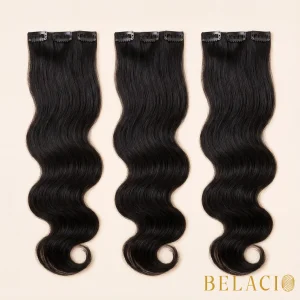
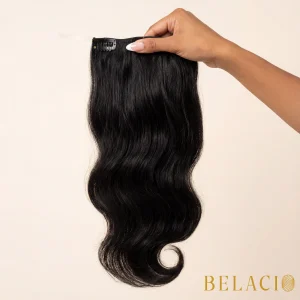
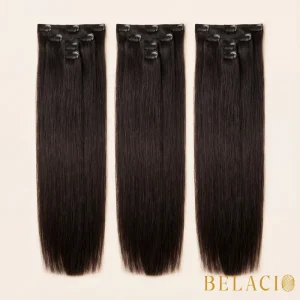
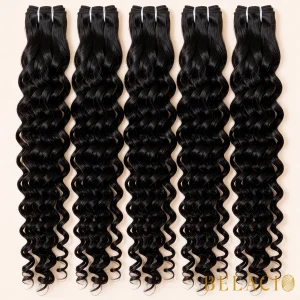
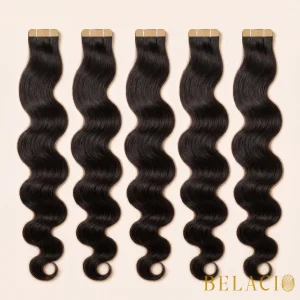
For a full-head installation, most clients need 100–200 grams total (1–2 bundles for subtle volume) or 200–300+ grams (2–3 bundles for dramatic fullness). At Belacio, our weft extensions start at $110 per bundle for double drawn virgin, and the weft hair extensions collection includes straight, wavy, curly, and body wave textures across multiple colors.
Here’s the real math that matters: cost-per-month. A $300 investment in two double drawn bundles that last 14 months comes out to $21.43/month. A $120 “deal” on single drawn that falls apart in 4 months? That’s $30/month — and you still need to buy again. The premium grade costs less over time. Every single time.
What Are the Pros and Cons of Weft Extensions Compared to Other Methods?
Weft extensions deliver the most volume per dollar of any extension method, but they require professional installation and regular maintenance appointments. That tradeoff is the core decision point.
Advantages: Maximum volume capacity (a full sew-in with 2–3 bundles creates density that tape-ins and clip-ins can’t match at the same price point), longest lifespan among semi-permanent methods (12–18 months versus 6–8 weeks for tape-ins), most versatile styling range (updos, braids, half-ups all work because the weft sits flat), and the best humidity performance for Caribbean climates since the secure sew-in installation won’t shift or slide in sweat and moisture.
Limitations: Professional installation required (2–3 hours, plus the cost of the stylist appointment), mandatory 6–8 week reinstallation cycle, slightly more weight on the scalp than tape-in methods, and they’re not ideal for very fine or thinning hair where the weight could cause traction stress.
For comparison: tape-in extensions offer faster installation (45 minutes) and lighter weight, making them the better choice for fine hair. Clip-in extensions are the no-commitment option — perfect for occasions, but not designed for daily all-day wear in humid conditions.
The right method depends on your hair density, lifestyle, and how much maintenance you’re willing to commit to. There’s no universal “best” — there’s the best for you.
Frequently Asked Questions
What is a weft of hair?
A weft is a continuous strip of human or synthetic hair sewn onto a reinforced thread base, creating a flat track designed for sew-in installation. Machine-sewn wefts use industrial stitching on polyester or nylon thread (0.5–1.5mm diameter), while hand-tied wefts are individually knotted for a thinner, more flexible profile. Weft extensions are the most common method for professional salon volume and length enhancement.
How long do weft hair extensions last?
Double drawn weft extensions last 12–18 months per installation cycle with proper care, while super double drawn can last 18–24+ months. The hair itself supports 2–3 years of cumulative use across multiple reinstallation cycles. Lifespan depends on maintenance habits — sulfate-free washing, heat protectant use, silk/satin sleep protection, and 6–8 week professional reinstallation.
How much do weft extensions cost?
Vietnamese virgin weft extensions cost $75–$195 per 100-gram bundle depending on processing grade and length. Double drawn bundles range $95–$135, while super double drawn runs $115–$195. A full-head installation requires 2–3 bundles ($190–$585 total). At Belacio, double drawn virgin weft bundles start at $110 with free shipping across Puerto Rico.
Do weft extensions damage your hair?
Weft extensions do not inherently damage natural hair when properly installed and maintained by a licensed stylist. Damage occurs from installations that are too tight (creating traction stress), skipping reinstallation appointments beyond 8 weeks (causing tension at shifted attachment points), or using wefts that are too heavy for fine hair density. Professional assessment before installation prevents these issues.
What does double drawn weft hair mean?
Double drawn means 70–90% of hair strands in the bundle maintain the same full advertised length, achieved through labor-intensive manual sorting that removes shorter strands. This creates uniform thickness from root to tip — no thin, tapered ends. The sorting process wastes approximately 25% of raw material, which accounts for the 15–25% price premium over single drawn alternatives.
Ready to find the right weft for your hair? Browse the complete Belacio weft collection — double drawn virgin, super double drawn, raw, and specialty textures from $110. Questions? Message me directly on WhatsApp at (787) 671-7122 and I’ll help you choose your grade, length, and texture.