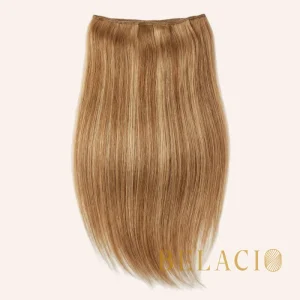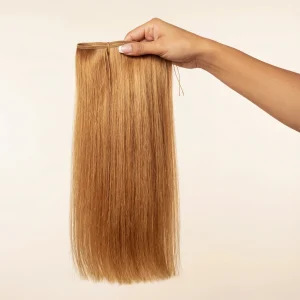
Las imágenes de cabello poroso muestran mechones con textura áspera, apariencia opaca sin brillo, puntas abiertas múltiples y frizz excesivo en humedad. El cabello poroso tiene cutículas levantadas que absorben agua rápidamente pero pierden hidratación en minutos. Esta condición afecta al 30-50% de cabellos procesados químicamente, especialmente en climas tropicales como Puerto Rico y el Caribe.
¿Tu champú desaparece en segundos como si tu melena fuera una esponja? ¿El frizz aparece apenas sales de casa en días húmedos? Estas son señales claras de cabello poroso, y ahora puedes identificarlo con un vistazo a las imágenes correctas.
En esta guía completa, descubrirás las 10 señales visuales que revelan si tu cabello tiene alta porosidad. Aprenderás qué causa esta condición, cómo confirmarlo con pruebas caseras simples, y qué soluciones realmente funcionan para el clima caribeño.
¿Qué es el cabello poroso y por qué luce diferente?
El cabello poroso es aquel cuya cutícula presenta escamas levantadas o dañadas que no sellan correctamente la fibra capilar. La cutícula es la capa externa protectora del cabello, compuesta por células superpuestas similares a tejas de un techo. Cuando estas escamas permanecen abiertas, el cabello absorbe humedad del ambiente instantáneamente pero la pierde con igual rapidez, creando un ciclo de sequedad constante.
Esta condición se manifiesta visualmente de forma muy específica. El cabello poroso luce opaco porque las cutículas abiertas dispersan la luz en lugar de reflejarla. Se siente áspero al tacto debido a la textura irregular de las escamas levantadas. Se enreda con facilidad porque las fibras rugosas se enganchan entre sí.
En Puerto Rico y el Caribe, donde la humedad relativa supera el 75% constantemente, el cabello poroso sufre aún más. El aire cargado de vapor penetra las cutículas abiertas, hinchando la fibra y provocando frizz incontrolable en minutos.
Característica Baja Porosidad Media Porosidad Alta Porosidad Absorción de agua Lenta, gotas resbalan Moderada, 30-60 segundos Instantánea, menos de 10 segundos Tiempo de secado 2-4 horas al aire 1-2 horas al aire 5-15 minutos al aire Textura al tacto Suave y lisa Normal Áspera y rugosa Nivel de brillo Alto, refleja luz Medio Opaco, sin reflejo Reacción a humedad Mínimo frizz Frizz moderado Frizz extremo instantáneo Retención de color Excelente, meses Buena, 6-8 semanas Pobre, desvanece en semanas
How to tell if your hair is porous? 3 foolproof home tests
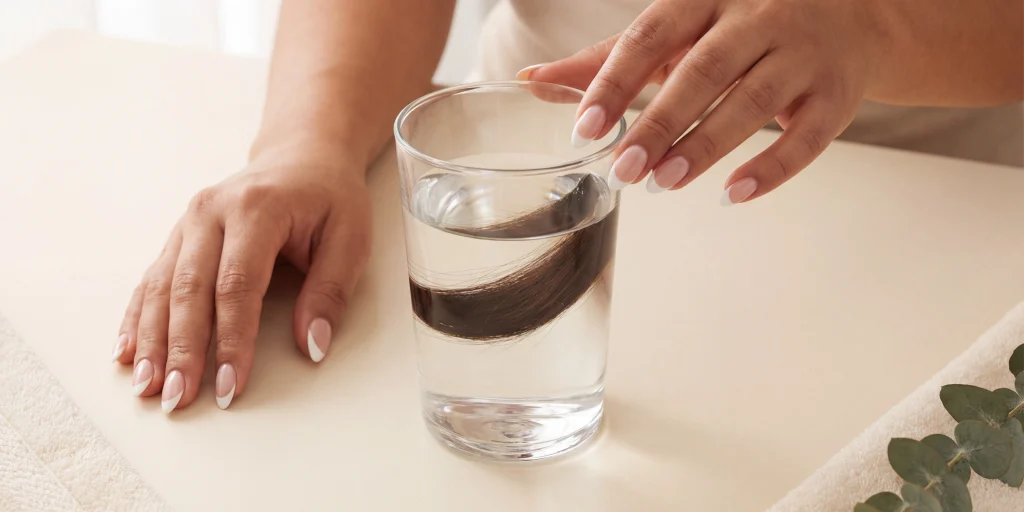
The float test is the most reliable at-home test for determining hair porosity. It involves submerging a clean, dry strand of hair in a glass of room-temperature water and observing its behavior for 2-4 minutes. High-porosity hair sinks quickly to the bottom because the open cuticles allow water to penetrate the hair fiber immediately.
Before performing any tests, wash your hair with a clarifying shampoo to remove any product residue that could affect the results. Take strands from different areas of your head, as porosity can vary.
Float Test (Cup Test)
Fill a clear glass with room temperature water. Place a clean, completely dry lock of hair, approximately 1 centimeter thick, into the glass. Wait 2-4 minutes without touching the glass.
If the strand floats on the surface the entire time, you have low porosity. If it stays in the middle of the glass, your porosity is normal. If it sinks to the bottom in less than 2 minutes, you have high porosity.
Spray Absorption Test
Spray water or diluted conditioner onto a dry strand of hair from about 10 centimeters away. Observe how the hair reacts.
Porous hair absorbs liquid instantly without leaving visible drops. Low-porosity hair repels water, forming small beads that slide off the surface.
Timed Drying Test
After washing your hair, let it air dry without any products or heat. Time how long it takes to dry completely.
High porosity hair dries in 5-15 minutes because it loses moisture as quickly as it absorbs it. Medium or low porosity hair can take 1-4 hours to dry naturally.
10 Visual Signs of Porous Hair in Pictures
Sign 1: Rough and Coarse Texture to the Touch
A rough texture is the first visual sign of porous hair. Raised cuticles create an uneven surface that feels like sandpaper when you run your fingers over the strand. Under a microscope, these cuticles appear as open, separate scales rather than smooth and overlapping.
This rough texture occurs because chemical and thermal damage erodes the edges of the cuticular scales. Irons at temperatures above 180°C, dryers without a diffuser, and harsh dyes progressively lift these scales until they lose their ability to seal.
In the Caribbean climate, the constant humidity exacerbates this texture. The hair absorbs moisture from the air, swells briefly, and as it dries, it leaves the cuticles even more open.
Sign 2: Dull Appearance Without Natural Shine
Porous hair looks dull and lifeless because the open cuticles don’t reflect light properly. Healthy hair has a smooth surface that acts like a mirror, producing that natural shine we associate with well-cared-for hair. Raised cuticles scatter light in multiple directions, eliminating glare.
In comparative photographs, the difference is dramatic. Low-porosity hair shows bright, defined highlights. Porous hair appears dull, lacking dimension and visual movement, even in direct light.
This dullness worsens after chemical treatments such as bleaching or straightening, which remove the natural lipid layer that protects the cuticle.
Sign 3: Excessive Frizz in Humid Environments
Uncontrollable frizz in humidity is the most visible sign of porous hair in tropical climates. When relative humidity exceeds 70%, highly porous hair absorbs water vapor from the air through its open cuticles. This moisture swells the hair fiber unevenly, separating the strands and creating that characteristic frizzy appearance.
In Puerto Rico, where the average humidity hovers around 78%, this reaction happens constantly. You leave the salon with perfect hair and in 15 minutes you have uncontrollable frizz.
Low porosity hair is more resistant because its closed cuticles act as a barrier against ambient humidity.
Signal 4: Multiple and Open Tips
Split ends, or trichiasis, are clear visual indicators of porous hair. Instead of ending in a clean point, the strands divide into two, three, or more branches that look like small brooms. These splits occur because the damaged cuticle no longer protects the inner cortex of the hair.
In close-up images, the split ends show separated, whitish, and dehydrated fibers. The damage can extend several centimeters if not cut in time.
The accumulated heat from straighteners and dryers, combined with the friction of styling, accelerates this splitting in porous hair.
Sign 5: Constant Tangles and Difficult Knots
Porous hair tangles constantly because the raised cuticles catch on each other like Velcro. Normal hair movement, friction against the pillow, or even the wind create knots that require time and patience to untangle.
The friction between rough fibers further damages the cuticles, creating a cycle of progressive deterioration. Brushing too hard only worsens the problem, causing breakage and more split ends.
Extensions on porous hair suffer from the same problem. The rough natural hair tangles the extensions, shortening their lifespan and creating a messy appearance.
Sign 6: Instant Water Absorption
Porous hair absorbs water almost instantly because its open cuticles offer little resistance. A drop of water placed on a dry strand disappears in 5-10 seconds, while on low-porosity hair the drop remains visible for minutes.
This ultra-fast absorption explains why the products don’t last. Shampoos, conditioners, and treatments penetrate immediately but evaporate just as quickly, leaving hair as dry as before.
In the shower, porous hair gets soaked instantly, feeling that heaviness that disappears minutes after drying it.
Signal 7: Ultra-fast Post-Wash Drying
High-porosity hair air dries in 5-15 minutes, much faster than healthy hair. The open cuticles allow moisture to escape as quickly as it entered, leaving the hair fiber dehydrated and straw-like.
This feature seems convenient, but it indicates a serious problem. Hair needs to retain a certain amount of internal moisture to remain flexible and strong. Rapid moisture loss causes chronic dryness, brittleness, and a tendency to break.
In contrast, medium porosity hair takes 1-2 hours to dry naturally, and low porosity hair can take 3-4 hours.
Sign 8: Color That Fades Quickly
Porous hair doesn’t retain dye because the open cuticles allow pigments to escape. A dye that lasts 6-8 weeks on healthy hair can fade in 2-3 weeks on highly porous hair.
The color molecules easily penetrate the raised cuticles, but wash out just as easily. The result is a dull, uneven color with darker roots and lighter ends.
Bleaching treatments worsen this condition because they remove natural melanin along with structural proteins, leaving the cuticles even more vulnerable.
Sign 9: Reduced Elasticity and Easy Breakage
Porous hair loses elasticity because cuticle damage affects the proteins in the cortex. A healthy strand can stretch up to 30% of its length without breaking. Porous hair breaks with minimal tension, especially when wet.
This fragility becomes apparent during everyday styling, when making ponytails, or simply separating strands. Short hairs that stand out from the overall length are evidence of this continuous breakage.
The constant loss of protein through open cuticles progressively weakens the internal structure of the hair.
Sign 10: Product That Doesn’t Last in the Hair
Hair products don’t last on porous hair because they penetrate the open cuticles and evaporate along with the moisture. You apply a leave-in conditioner in the morning, and by midday your hair is as dry as it was before you applied it.
This characteristic affects all products: oils, serums, moisturizers, heat protectants. Instant absorption without retention creates the illusion that you need to apply more product, when the real problem is the damaged structure of the cuticle.
Sealing products such as thick butters and oils help create a physical barrier that better retains moisturizing treatments.
Why Does Hair Become Porous? Main Causes
High hair porosity results from cumulative damage to the cuticle caused by chemical, thermal, environmental, and mechanical factors. Each type of damage progressively lifts the cuticle scales until they lose their ability to close and protect the hair fiber. Understanding these causes allows us to prevent further damage.
Chemical damage: Permanent dyes, bleaching, formaldehyde-based straightening treatments, and perms alter the cuticle structure. Alkaline chemicals open the scales to allow dye to penetrate, but repeated use prevents them from closing properly.
Heat damage: Flat irons, hair dryers, and curling irons at temperatures above 180°C evaporate the hair’s internal moisture and partially melt the cuticle proteins. Constant heat without protection causes irreversible damage.
Environmental damage: The sun’s UV radiation degrades hair proteins. Salt water and chlorine draw out moisture and minerals. The tropical humidity of the Caribbean causes cycles of swelling and shrinkage that weaken the cuticles.
Mechanical damage: Aggressive brushing, tight hairstyles, tight elastics and friction with cotton pillows physically break the edges of the cuticular scales.
How to Repair Porous Hair? 5 Effective Treatments
High-porosity hair requires a two-pronged approach: sealing the cuticles to retain moisture and strengthening the structure with protein. Effective treatments combine moisturizing products with ingredients that create a protective barrier over the damaged hair fiber. Visible results appear in 4-6 weeks of consistent use.
1. Protein Conditioners to Seal Cuticles
Hydrolyzed proteins such as keratin, collagen, and silk protein temporarily fill the gaps in the damaged cuticle. Apply a protein treatment weekly, leaving it on for 15-20 minutes under gentle heat before rinsing with cool water.
Cold water helps to temporarily close the cuticles, improving shine and reducing frizz for several days.
2. LOC/LCO Technique for Retaining Moisture
LOC stands for Liquid-Oil-Cream: apply a water-based product first, then a sealing oil, and finally a moisturizer. This technique creates layers that lock in moisture within the porous fiber.
For very porous hair, LCO (Liquid-Cream-Oil) works best because the final oil completely seals the cuticles.
3. Nanoplasty Treatments in the Salon
Nanoplasty uses amino acid and protein particles that penetrate the hair fiber and rebuild it from within. Unlike traditional keratin treatments, it does not contain formaldehyde and allows for coloring after the treatment.
The results last 2-4 months, significantly reducing frizz and improving manageability.
4. Low Porosity Extensions for Protected Volume
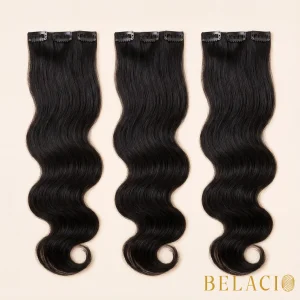
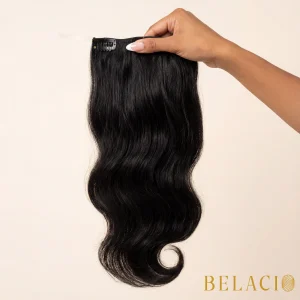
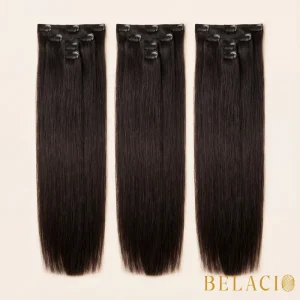
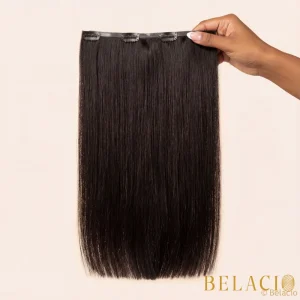
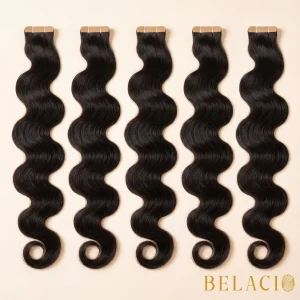
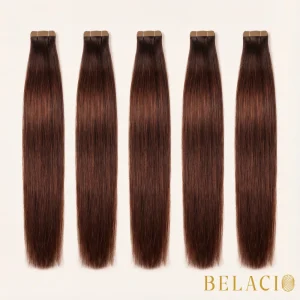
Virgin human hair extensions with aligned cuticles offer instant volume while protecting your natural hair. Low-porosity Vietnamese hair withstands Caribbean humidity for up to 12-18 months without frizz or tangling.
Belacio extensions use 100% virgin hair with intact cuticles all facing the same direction, eliminating the friction that causes tangling. Clip-in options allow for daily wear without damage, while tape-in and weft options offer semi-permanent solutions.
5. Balanced Weekly Routine Protein-Moisture
The balance of protein and moisture is key for porous hair. Too much protein leaves hair stiff and brittle. Too much moisture leaves it limp and shapeless.
Structure your week: Monday, deep hydration with a mask; Wednesday, a light protein treatment; Friday, sealing with oils; Sunday, a gentle wash and detox. Always rinse with cold water to close cuticles.
Hair Extensions for Porous Hair: Why Quality Matters
Generic extensions worsen the problems of porous hair because their rough surface increases friction and tangling. Synthetic or silicone-treated hair has artificial cuticles that snag on natural porous fibers, causing breakage and shortening the lifespan of both.
Virgin human hair extensions with aligned cuticles solve this problem. When all the scales point in the same direction, the surface is smooth and doesn’t snag on your natural hair. The result is less tangling, less damage, and extensions that last longer.
Vietnamese hair is naturally low porosity, with thick, resilient cuticles that withstand humidity, heat, and chemical treatments. In tropical climates like Puerto Rico, this resilience makes the difference between extensions that last 3 months and extensions that last 12-18 months.
Belacio imports Vietnamese hair directly from verified factories, eliminating intermediaries who add silicone treatments that compromise quality. Options include clip-ins for flexible everyday wear, tape-ins for semi-permanent volume, and wefts for professional installations.
Frequently Asked Questions about Porous Hair
Can high hair porosity be reversed?
High porosity is not completely reversed because the cuticle damage is structural. However, protein treatments and sealing techniques can significantly improve appearance and manageability. New hair growing from the root will have normal porosity if you avoid the factors that caused the original damage.
Which extensions are best for porous hair?
Virgin human hair extensions with aligned cuticles work best for porous hair because their smooth surface doesn’t cause additional friction. Belacio’s Vietnamese hair, with its naturally low porosity, resists Caribbean humidity and lasts 12-18 months without frizz or excessive tangling.
Does the Caribbean climate worsen porosity?
The constant humidity of the Caribbean exacerbates the symptoms of porous hair but doesn’t cause porosity itself. Already damaged cuticles absorb moisture from the tropical air, swelling and creating frizz. Protecting hair with sealing products and low-porosity extensions minimizes this effect.
How long does it take to repair porous hair?
Sealing treatments show immediate results that last for days. Sustained improvement requires 4-6 weeks of consistent routine. Full recovery only occurs when the damaged hair grows out and is cut, which takes 12-24 months depending on the desired length.
Can I dye porous hair without damaging it further?
Dyeing porous hair is possible but requires extra precautions. The dye penetrates faster, so reduce processing time. Use ammonia-free formulas and apply a protein treatment a week before and after. The color may fade faster, so choose shades close to your natural color.
Conclusion: Your Action Plan for Healthy Hair
Now you recognize the 10 visual signs of porous hair: rough texture, dullness, frizz in humidity, split ends, constant tangling, instant water absorption, ultra-fast drying, color fading, reduced elasticity, and products that don’t last. With this information, you can confirm your porosity type using at-home tests and take immediate action.
Your plan starts today. Perform the float test on a clean, dry strand of hair. If you confirm high porosity, implement a weekly routine of hydration, protein, and sealing. Consider Vietnamese hair extensions with aligned cuticles for protected volume while your natural hair recovers.
Porous hair isn’t a permanent condition. With the right treatments and quality products, you can transform your frizzy mane into manageable, shiny, and healthy hair, even in the humid Caribbean climate.
Visit belacio.hair to explore premium Vietnamese extensions that withstand tropical humidity. Your hair deserves the shine you’ve always wanted.